  What's New! Detailed Sitemap All images © by Roberto Piperno, owner of the domain. Write to romapip@quipo.it. Text edited by Rosamie Moore. Page added in May 2008. |
 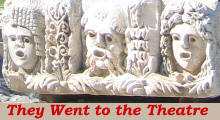 - Termessos - Termessos(theatrical masks at Myra) Although close to the Mediterranean Sea on the map, Termessos did not benefit from its warm climate, because it was built at an altitude of more than 3,500 feet on the western slope of a mountain (Gulluk Dag) reaching 5,000 feet. The town was part of Pisidia, an ancient region which was located north of Lycia and west of Pamphylia.
Today it is difficult to understand how Termessos could flourish, because the site looks so isolated: not the crow of a cock, nor the bark of a dog break the peace and quiet of the ancient town. Not even goats seem willing to venture through its ruins.
Due to its remoteness and its strong defensive position, Termessos avoided being sacked and burnt by the many armies which crossed the region. It eventually became part of the Kingdom of Pergamum, but as an allied town rather than a possession. The Romans too permitted a certain degree of autonomy to Termessos. Although the immediate whereabouts of the town did not lend themselves to farming, the nearby tableland was fertile and suitable for husbandry.
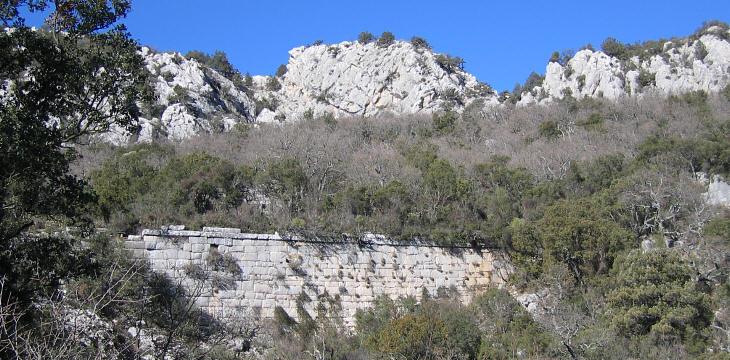
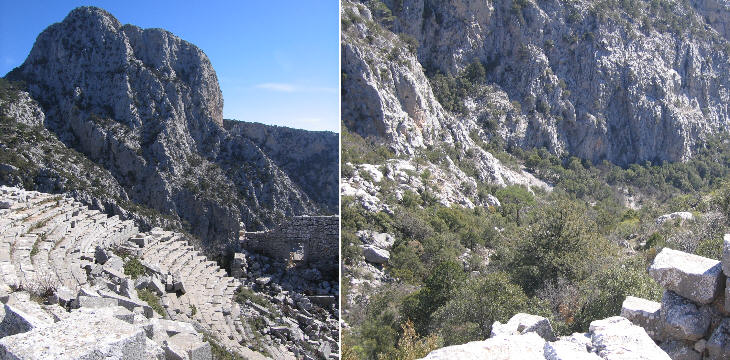
Usually ancient theatres were located at the foot of a hill or mountain; that of Termessos is somewhat extraordinary because it was built on the edge of a rock at one of the highest point of the town. The site was chosen because the rock could be cut in order to obtain rows of seats, but during the Roman rule the theatre was enlarged by adding more seats which were supported by imposing walls. Termessos had a quarry of grey stone very near the town.
It is uncertain when Termessos was abandoned, but this probably occurred even before the Arab raids brought misery to the whole region in the VIIth century AD. No other town was founded in the vicinity and so the stones of Termessos were not used to build fortresses and churches elsewhere. The visitor has the impression of seeing a town suddenly abandoned because of an earthquake or a pestilence; these actually occurred in many other towns of the region as well, but they did not lead to such dramatic consequences.
The theory which attributes the abandonment of Termessos to a devastating earthquake is somewhat contradicted by the state of many buildings including the theatre; their walls did not collapse and have withstood the 1,500 years of total neglect which followed.
An aqueduct provided Termessos with water; this was stored in five underground cisterns which were cut into the rock; one can see the hydraulic devices used to convey the water into the cisterns and control its pressure. Because the archaeological site is not subject to strict control, authorities have relocated to the Museum of Antalya most of the reliefs and inscriptions found at Termessos.
Although gymnasia were present in all towns of the ancient world and testified to the importance given to education (of both soul and body) by the Greeks and the Romans, they rarely have withstood the ravages of time. These facilities mainly consisted of porticoes surrounding open spaces where the young had physical training; in Termessos, due to the climate, large vaulted rooms surrounded a relatively small courtyard. Their design is both imposing and elegant.
At a certain point Termessos was enlarged with the development of a lower town located half a mile down in the valley; most of the ruins belong to buildings erected during the Roman rule; they appear in worse condition than those of the upper town, perhaps because they were exploited as a quarry as they were more accessible. Similar to many other towns of Asia Minor, Termessos also had a building associated with Emperor Hadrian, during whose rule a temple was built in the lower town.
Introductory page Priene Miletus Didyma Iasos Euromos Milas Kaunos Telmessos Tlos Xanthos Letoon Patara Antiphellos Simena Myra Phaselis Attalia (Antalya) Perge Aspendos Side Map of Turkey with all the locations covered in this website     |