  What's New! Detailed Sitemap All images © by Roberto Piperno, owner of the domain. Write to romapip@quipo.it. Text edited by Rosamie Moore. Page added in April 2008. |
 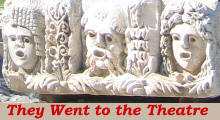 - Miletus - page one - Miletus - page one(theatrical masks at Myra) Miletus was located at the head of a promontory which protected several small bays. It is said that the town had four harbours. For centuries it was the most important town of the region; it was destroyed by Emperor Darius for having led a rebellion against the Persians, but it was soon rebuilt following the design of his architect Hippodamus.
Today Miletus is surrounded by a fertile coastal plain and its imposing theatre is no longer a reference point for seafarers.
The original theatre exploited the slope of the hill to obtain a series of benches; the current building is the result of a major enlargement which occurred in the IInd century AD. The new benches were supported by walls and terraces and the audience could easily enter or leave the theatre via large vomitoria, passages situated behind the seats.
The theatre could seat an audience of 15,000; the representatives of the emperor or the highest magistrates of Miletus sat in a central loggia. The audience had an outstanding view over the western harbour and on the bay.
The elaborate decoration of the theatre is typical of the IInd century; the capitals combine elements of the Ionic and Corinthian orders and in addition have an egg-and-dart ornamentation between the volutes (see an egg-and-dart frieze in the cornice of the Temple to Hadrian in Rome). Some pillars were decorated with mermaids, a recognition of the importance of the sea to Miletus.
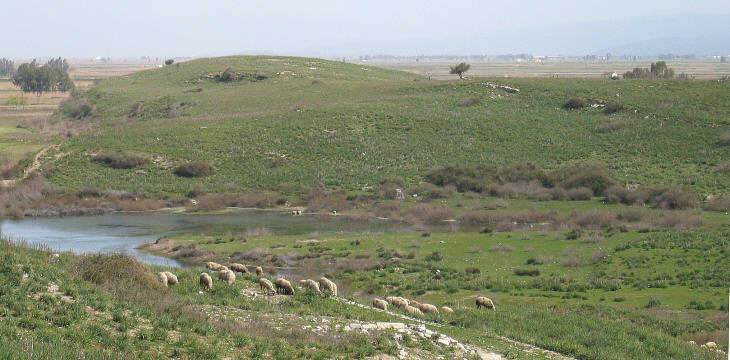
The eastern harbour was known as the Lion Harbour because it was guarded by two statues of lions (similar to Piraeus). Its shape is still evident, although it is now a meeting point for sheep, rather than ships.
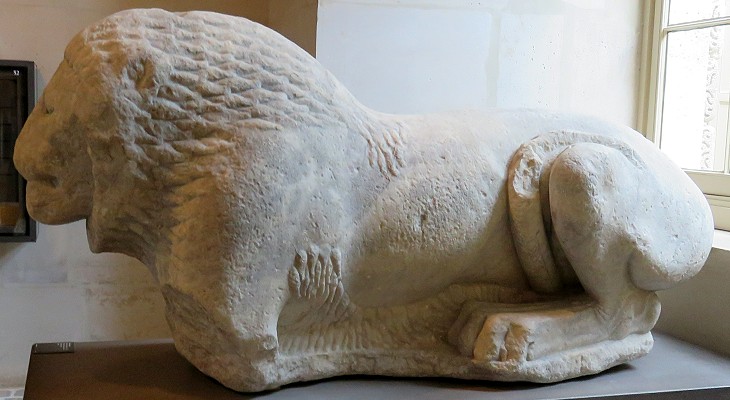
This lion was found in a necropolis, but it might give an idea of those who guarded the harbour.
The security of the sea routes to Syria and Egypt was a key factor for the prosperity of Miletus; this explains why its citizens built a monument (near Lion Harbour) to celebrate the 67 BC victory of Pompey against the pirates who assaulted convoys of ships and even raided coastal towns. A few years later the monument was rededicated to Emperor Augustus for his 31 BC victory at Actium. That victory led to the conquest of Egypt by the Romans: that in turn meant for Miletus an increased volume of trade with that new Roman province.
During some periods of the year (the photo above was taken in early March 2008) parts of the town are covered by shallow water: yet it is possible to see under its reflecting surface the foundations of a tholos (circular temple) dedicated to Apollo. The temple of Apollo was surrounded by a square portico and it was the starting point of processions going to Didyma, where a major shrine was dedicated to this god.
The initial part of the holy road leading to Didyma crossed the centre of Miletus. It was flanked by porticoes and behind them there were temples, baths, gymnasiums and a market.
The holy road was interrupted by the southern market of Miletus: its entrance was particularly imposing, but one needs to go to Berlin to see it (it opens in another window). At a straight angle with the market the Romans built a large fountain decorated with many statues.
The construction of the Nymphaeum and the pavement of the Holy Road were promoted by Marcus Ulpius Traianus and by his son who had the same name, but added to it that of Nerva, the emperor who adopted him. The Market Gate was built by Emperor Hadrian a few years later. Move to page two.     |