  What's New! Detailed Sitemap All images © by Roberto Piperno, owner of the domain. Write to romapip@quipo.it. Text edited by Rosamie Moore. Page added in May 2008. |
  - Telmessos - Telmessos(Theatrical masks at Myra) Telmessos, Anastasiopolis, Makri, Fethiye are the four names given through the centuries to a well protected port in today's southern Turkey.
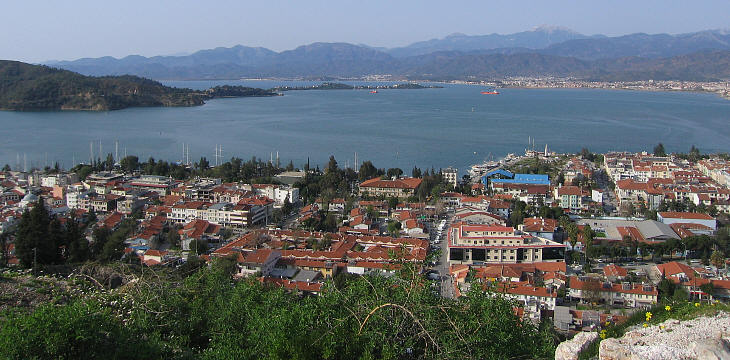
By looking at the bay from the ancient acropolis it is easy to understand why the site was never abandoned. Although Telmessos did not have a natural harbour which fitted the seafaring needs of antiquity, yet the shape of the bay granted favourable sea conditions due to a group of islets which acted as breakwaters.
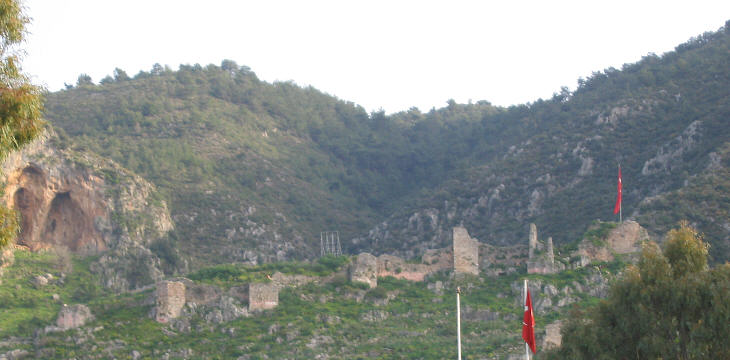
Fethiye (today's Telmessos) is a booming holiday resort and in particular the starting point of weekly cruises along the Mediterranean coast of Turkey. Maybe it is with the objective of pleasing travellers that tourist guides say that the Crusaders or the Knights of Rhodes built a fortress on the ancient acropolis. In point of fact the fortifications go back to the Byzantine period and were a protection against Arab raids. They were strengthened by the Ottomans.
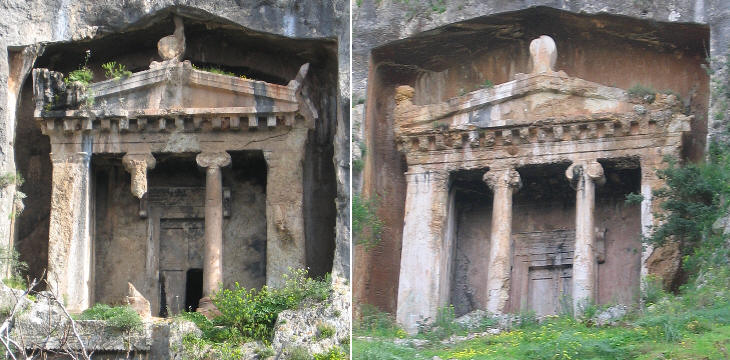
Telmessos was renamed Anastasiopolis in the VIIIth century, most likely to celebrate the efforts made by Emperor Anastasius II to stop Arab raids. The name did not last and eventually the town became known as Makri. Apart from an Ottoman garrison in the fortress and a few other Ottoman representatives, its inhabitants were all Greek. In 1923 Greece and Turkey agreed on a vast exchange of population and almost all the inhabitants had to leave: some went to Nea Makri, a new village on the eastern coast of Attica, not far from Athens. The town was eventually named Fethiye after Fethi Bey, one of the first Turkish aviators. Earthquakes and wars have destroyed most of the monuments of the past; the rock-cut tombs are an exception.
The more elaborate rock-cut tombs were designed in order to resemble a temple in antis: these small temples characterized Hellenistic architecture. Antae is a Latin architectural term describing the posts or pillars on either side of the entrance of a Greek temple - the slightly projecting piers which terminate the walls of the cell. When there are columns between antae, as in a porch facade, the columns (and therefore the temple) are said to be in antis.
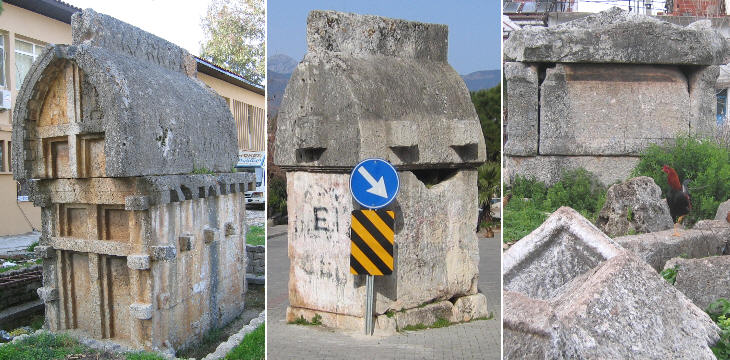
The inhabitants of Lycia developed a unique kind of sarcophagus: their lids had a "Gothic" shape which archaeologists suggest may represent a capsized boat; they were not placed in a necropolis in an orderly manner; usually they were free-standing. During the Roman rule the "Gothic" lid was occasionally replaced by a gable-shaped lid.
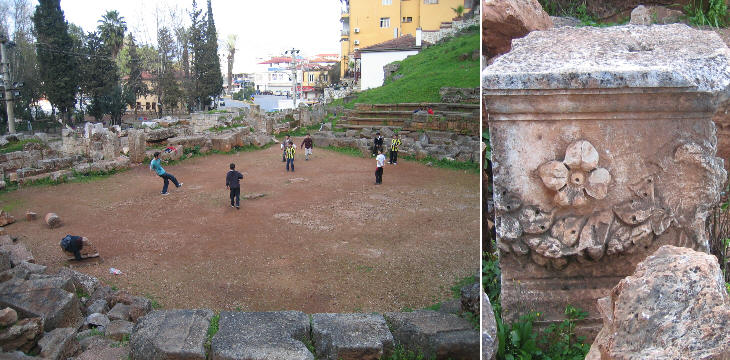
Early XIXth century travellers were impressed by the ruins of a Roman theatre which stood almost on the shoreline. Today it is strangled by busy roads and modern buildings.
Introductory page Miletus Priene Didyma Euromos Iasos Kaunos Milas Tlos Xanthos Letoon Patara Antiphellos Simena Myra Phaselis Termessos Attalia (Antalya) Perge Aspendos Side Map of Turkey with all the locations covered in this website     |