Autism History And Statistics

 |
The Autistic Spectrum |
|
|
 
|
|
By Raymond W. Gallup & F. Edward Yazbak, MD, FAAP http://www.vaproject.org/yazbak/1-in-150-is-really-1-in-67-20071005.htm On February 8,
2007 the CDC released “New Data on Autism Spectrum Disorders (ASDs) from Multiple Communities in
the United States.” (1) Since then, most people and the press have
been under the impression that in the United States, the “new” CDC- reported ASD prevalence rate of 1 in 150 was
a recent discovery that was current for 2007 when indeed it was not at all. The study did not document a prevalence
of 1 in 150 among children born now or five years ago. The study revealed that among U.S. children born in 1994, thirteen
years ago, 1 in 150 on average had a spectral disorder. According to the official press release:
“The Centers for Disease Control and Prevention (CDC) reported findings today from the first and largest summary of
prevalence data from multiple U.S. communities participating in an autism spectrum disorder (ASD) surveillance project.
The results showed an average of 6.7 children out of 1,000 had an ASD in the six communities assessed in 2000, and an average
of 6.6 children out of 1,000 having an ASD in the 14 communities included in the 2002 study. All children in the studies
were eight years old because previous research has shown that most children with an ASD have been identified by this age for
services.” The U.S. Department of Education
has recently released the official figures for autism/ASD by age and state for school year 2006-2007, in accordance with the
Individuals with Disabilities Education Act’s requirement that comprehensive annual reports be published and presented
to the United States Congress. Children born in 1994 and who
according to the 2002 CDC study had an ASD prevalence of around 1 in 150, probably started first grade in the fall of
2000. In Table I, we compared by state, the number
of 6 year-old children with Autism/ASD in U.S. schools in 2000-2001 with those similarly diagnosed children of the same age
who attended school in 2006-2007. The percent increase in that particular group since the CDC’s acclaimed 1 in
150 prevalence figures is listed by state in the right column. All states, except Alaska and Oklahoma had
increased first grade enrollment of children with spectral disorders. Thirty five (35) states more than doubled their
load and consequently their financial needs and in New Mexico, the number of ASD students quadrupled between 2000 and 2006.
The District of Columbia did not report.
STATE 2000-2001 2006-2007 % increase Alabama 47 146 211 Alaska 30 28 -6 Arizona 151 454 201 Arkansas 95 106 12 California 1,539 3,465 125 Colorado 55 156 184 Connecticut 146 343 135 Delaware 22 56 155 District of Columbia 11 x 0 Florida 481 1,080 125 Georgia 273 551 102 Hawaii 42 76 81 Idaho 28 62 121 Illinois 499 945 89 Indiana 254 576 127 Iowa 33 56 70 Kansas 84 141 68 Kentucky 96 217 126 Louisiana 102 173 70 Maine 57 145 154 Maryland 232 414 78 Massachusetts 29 604 108 Michigan 415 735 77 Minnesota 240 695 190 Mississippi 31 64 106 Missouri 198 410 107 Montana 24 35 46 Nebraska 32 87 172 Nevada 59 214 263 New Hampshire 28 70 150 New Jersey 470 1,002 113 New Mexico 14 63 350 New York 664 1,306 97 North Carolina 273 450 65 North Dakota 12 20 67 Ohio 306 798 161 Oklahoma 67 43 -36 Oregon 213 452 112 Pennsylvania 427 1,065 149 Puerto Rico 68 167 146 Rhode Island 34 89 162 South Carolina 88 216 145 South Dakota 23 47 104 Tennessee 83 251 202 Texas 738 1,629 121 Utah 79 167 111 Vermont 12 21 75 Virginia 198 484 144 Washington 122 323 165 West Virginia 49 90 84 Wisconsin 201 461 129 Wyoming 9 27 200 Total 9,483 21,275 124 In February 2007, Marshalyn Yeargin-Allsopp, MD, MPH chief of the CDC's autism program was quoted as saying (1):
Parents of children with autism would probably agree with Dr. Yeargin-Allsopp’s first two points and most of them would gladly share their thoughts and ideas about the causes of autism, if she cared to listen. In the same press release (1) CDC Director Gerberding was quoted as saying: “Our estimates are becoming better and more consistent, though we can't yet tell if there is a true increase in ASDs or if the changes are the result of our better studies.” No one asked Dr. Gerberding why, when many at the CDC knew that their own 2002 study yielded a prevalence of 1 in 150 among eight-year old children, the CDC approved, distributed and advertised an “Autism A.L.A.R.M” (2) in January 2004 that proclaimed that “1 in 166 children are diagnosed with an autism spectrum disorder.” Dr. Gerberding did not volunteer and it appears that no one thought of asking her why the CDC kept the results of the 2000 and 2002 studies secret for so long or if a third CDC study had been done in 2004 that was still “Top Secret” for undisclosed reasons. In any case, if according to the CDC, the ASD prevalence rate was 1 in 150 on average among children born in 1994 and if the number of 6 year-old children with ASD known to the U.S. Department of Education indeed increased by 124% nationwide over the last six school years, then it is likely that among children born in 2000 who are now registered in U.S. schools, the prevalence rate of autistic spectral disorders is around 1 in 67, on average. Now that would be a catastrophe of unprecedented proportions. Since the CDC 2002 study results were released in early 2007, no one in authority has bothered to correct the false impression that the “new” prevalence was current. Every day tens of newspaper articles and news items discuss the alarming increase in autism “that has now reached 1 in 150” and promptly reassure people that it is not related to vaccines and a mercury preservative. It will be interesting to see when the head of the CDC’s autism program will reveal to the Nation that the prevalence of autism and other spectral disorders is really more than double that estimate. In Table II, we have compared the number of 6-21 year-old students with ASD who attended U.S. schools in the different states, the District of Columbia (DC) and Puerto Rico in school years 1992-1993 and 2006-2007.
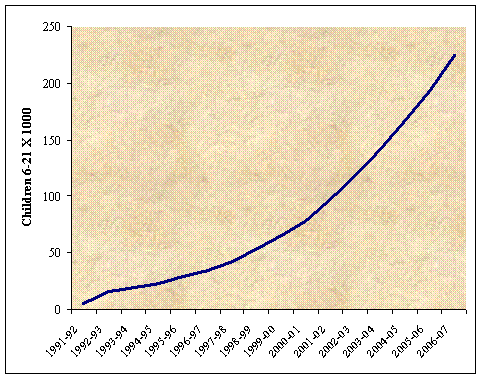
There were 193,481 students with ASD, age 6 -21, registered in school year 2005-2006. The 224,415 students in the same category in school year 2006-2007 reflect a 16% increase over 1 year. The U.S. Department of Education started providing enrollment statistics on pre-school children age 3-5 in 2000. In Table III we compare those original statistics with the recent figures for school year 2006-2007.
Here again, the number of children with Autism/ASD more than doubled in six years. Alaska did not report and the number of affected children decreased in Iowa and New York by 30 and 32% respectively. In all other states and in DC, the number of 3 to 5 year-old children with ASD increased significantly over the last six years with thirty seven states reporting increases of over 100%. New Mexico, Washington State and Massachusetts had the highest increases: 1833%, 703% and 584% respectively. The Diagnostic and Statistical Manual of Mental Disorders clearly outlines the required criteria for the diagnosis of autism and autistic disorders. The manual’s 4th and last revision was introduced in 1994. Since then, the diagnostic criteria of DSM-IV have not changed in any way. There have been incessant claims that the increasing prevalence of ASD is only due to the less stringent “newer” diagnostic criteria. We disagree and we have shown that indeed DSM-IV criteria are more numerous and specific. (3) In any case, it is hard to believe that anyone would even think that in this day and age, school districts would be willing to pay thousands of dollars to provide specialized remedial services to children and adolescents who do not have a spectral disorder and distinct special needs. More ludicrous is the idea that these services would be perpetuated without a convincing reason year after year. Table IV lists the number of students aged 6 to 21 who were registered in U.S. schools since DSM-IV and the yearly increases since then.
In 1994, the population of the United States was estimated at 260,204,000. It increased by 14.7% to 298,444,215 in 2006. During the same period, the number of students aged 6-21 with autistic spectral disorders known to the U.S. Department of Education increased by 885% from 22,780 to 224,415. Table V lists the yearly increases in the number of children who are 3 to 5 years old and who carry the diagnosis of autism or ASD.
This 125% increase in children 3 to 5 years old in 6 years is 20 times greater than the percent increase in the US population since the 2000 census when it was 281,421,906. The following graph illustrates the increase in the number of children with autism and ASD during the last 15 years, in fact since autism was listed as a separate category by the U.S. Department of Education.
We believe that the alarming trend that we have described must be halted and reversed before another generation of children is lost and thousands more families are destroyed. Shame on them who have chosen to close their eyes, their ears and their minds to this tragic and serious problem! References
Source url: http://www.whale.to/v/yazbak44.html
Why hasn't this information been updated since December 2007? "In January 2008, the Department began transitioning its CDER database to a revised instrument with more current diagnostic standards and updated evaluation questions. This transition is taking place in phases with the full transition expected to be completed in 2011. As a result of this transition, no new CDER information will be released until Fall 2008." (As of December 2008, this information has not yet been released.) |
 <!--[endif]-->