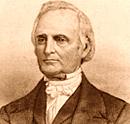
Rev. John Rankin Welcome to the book by Rev. John Rankin, Letters on American Slavery (1823-1833-1839).
To go at once to the "Table of Contents," click here.
Prior to the 1861-1865 War, there were a number of Christian abolitionists who opposed slavery. They included Rev. George B. Cheever, Harriet B. Stowe, Rev. John G. Fee, Rev. Theodore D. Weld, Rev. Stephen S. Foster, Deacon James Birney, Rev. William W. Patton, Rev. Beriah Green, Rev. Parker Pillsbury, etc. Nowadays, their Bible-based reasons are generally unknown.
Other abolitionists wrote to show the unconstitutionality of slavery. They included: James Otis (1761), John Adams (pre-1776), Samuel May (1836), Salmon P. Chase (1837), Gerrit Smith (1839), George Mellen (1841), Alvan Stewart (1845), Lysander Spooner (1845), Benjamin Shaw (1846), Horace Mann (1849), Joel Tiffany (1849), William Goodell (1852), Abraham Lincoln (1854), Edward C. Rogers (1855), and Frederick Douglass (1860).
This series of websites educates by making the text of their writings accessible. Whether or not you agree with their position, it is at least a good idea to know what it was!
This site in the series reprints the named book by Rev. John Rankin (1793-1886), pastor of the Presbyterian churches of Ripley and Strait-Creek, Brown County, Ohio, specifically, the fifth edition of 1839.
The Ohio area of Rev. Rankin's activism was near the Kentucky border. His farmsite (with a tall lighthouse) was visible for miles, including some distance into Kentucky.
Rev. Rankin was a devout, kindly, compassionate man, who had emigrated north out of pro-slavery Tennesseee, had a long record of activism, and is recognized in Ohio history for it.
Rev. Rankin was not only a writer 1820's on. He was also an activist, a participant, a "rescuer." He actively participated in the "Underground Railroad." This meant that mistreated slaves escaping North from Kentucky could find his farmsite, be welcomed, and be passed on further North into freedom, where the U.S. Constitution was respected in this regard.
Activism (even for Bible and Constitutional principles) then was dangerous. Some abolitionists, e.g., Rev. Elijah P. Lovejoy were murdered. Rev. Rankin was lucky in 1841, to win a gun-battle against attackers from Kentucky.
In addition to being contrary to the Bible, as Rankin and others showed, slavery also violated the U.S. Constitution. Adhering to both, Rankin thus functioned, in law, as a "rescuer" and "Private Attorney General." Rev. Rankin wrote on the rescue doctrine, p 101, infra, in context of the "original grant," p 100.
Here now is the text of Rev. Rankin's book.

Letters on American Slavery
Addressed to Mr. Thomas Rankin,
Merchant at Middlebrook,
Augusta County, Virginia
,
by
Rev. John Rankin
(Ohio, 1823; Boston: Garrison & Knapp, 1833;
Newburyport: Charles Whipple, 1837;
Isaac Knapp, 5th ed., 1839;
and NUP, 1970)

CONTENTS
Prefaceiii
I. Rebutting Prejudice5
Different Skin Color
6
Slaves' Degradation
10
Covetous Love of Gain
12
II. Slavery Not Intended by the Creator14
III. Evils of Slavery19
Ignorance
19
Censorship
21
Anti-Education
21
Anti-Gospel
24
IV. Denial of Education25
Talents' Suppressed
26
Immorality
28
V. Injustice and Cruelty31
Denial of Life Necessities
32
Chastity Violations
34
VI. Power of Slavers36
Marriage Ban
37
Forced Separations
38
Splitting Families
40
VII. Power of Slavers, More Details43
Forbidding Religion
43
Sadism - Brutality
45
Beating the Sick
48
VIII. Cruelty of Punishments49
Torture
52
Axe Murder Case
57
IX. Inhumane60
Domestic Violence
60
Idleness
61
Vice
62
Health Debilitation
63
Poverty
64
Ignorance
65
Societal Decline
66
Cruelty
67
Tyranny
67
X. The Title Issue70
XI. Prohibited by the Bible73
Noah's Curse
73
Abraham's Example
76
Mosaic Institutions
79
XII. Rebutting the "Servant" Claim83
'Doulos'
83
'Yoke'
87
Slavery Ban
91
XIII. Bible Anti-Southern Slavery94
Genesis 15:14
94
Exodus 21:16
97
Deuteronomy 23:15-16
101
Isaiah 58:6
101
Matthew 7:12
102
Excuses for Slavery104
Government
104
Laws
104
Incapacity
104
Betterment
106
Fatalism
107
Prejudice
106
Conclusion108

Preface

THE following Letters were originally designed for the benefit of the Brother to whom they were addressed. For his convenience they were inserted in the Castigator, and by that means were first brought to public view.

The solicitations of a few friends, in connection with the desire of aiding and encouraging every effort for the liberation of the enslaved and degraded Africans, were the means of bringing them before the public a second time, and in another form.

They have received several alterations and additions. And some efforts have been made to render the work more complete than it was in its original form, but still, it is far from possessing that excellence of composition which the importance of its subject requires. Therefore, it is desired that its imperfections may be attributed to the weakness of its author, and not to that of the cause it is intended to support.

But little can reasonably be hoped in relation to the success of this work, when it is considered that, in addition to the difficulties arising from its own imperfections, it must bear the charge of fanaticism, and contend with prejudices that have been rapidly increasing for ages. In opposition to it, more than ten thousand envenomed tongues, and pens dipt in the gall of unrelenting avarice, may be expected to plead the cause of injustice.

These difficulties, however, should be considered as so many arguments in favor of the work. If but a little good can be done, it is the more necessary that that little should be done. That involuntary slavery is a very dangerous evil, and that our nation is involved in it, none can, with truth, deny. And that the safety of our government, and the happiness of its subjects, depend upon the extermination of this evil, must be obvious to every enlightened mind. Nor is it less evident, that it is the duty of every citizen, according to his station, talents and opportunity, to use suitable exertions

-iii-

for the abolition of an evil which is pregnant with the growing principles of ruin. Surely, no station should be unimproved, no talent, however small, should be buried, nor should any opportunity of doing good be lost, when the safety of a vast nation, and the happiness of millions of the human family, demand prompt and powerful exertions. Everything that can be done, either by fair discussion, or by any other lawful means, ought to be done, and done speedily, in order to avert the hastening ruin that must otherwise soon overtake us!

Let all the friends of justice and suffering humanity, do what little they can, in their several circles, and according to their various stations, capacities and opportunities; and all their little streams of exertion will, in process of time, flow together, and constitute a mighty river that shall sweep away the yoke of oppression, and purge our nation from the abominations of slavery.

-iv-

LETTERS ON SLAVERY

I. Rebutting Prejudice

MY DEARBROTHER:

I received yours of the 2d December, with mingled sensations of pleasure and pain; it gave me pleasure to hear of your health, and pain to hear of your purchasing slaves. I consider involuntary slavery a never-failing fountain of the grossest immorality, and one of the deepest sources of human misery; it hangs like the mantle of night over our republic, and shrouds its rising glories.

I sincerely pity the man who tinges his hand in the unhallowed thing that is fraught with the tears, and sweat, and groans, and blood of hapless millions of innocent, unoffending people.

A mistaken brother, who has manifested to me a kind and generous heart, claims my strongest sympathies. When I see him involved in what is both sinful and dangerous, shall I not strive to liberate him? Does he wander from the paths of rectitude, and shall not fraternal affection pursue, and call him from the verge of ruin and the unperceived precipice of wo, to the fair and pleasant walks of piety and peace? Shall I suffer sin upon my brother? No—his kindness to me forbids it, fraternal love forbids it, and what is still

-5-

more to be regarded, the law of God forbids it. Though he has wandered for the moment, may I not hope to show him his error, and restrain his wanderings?

Under such views and feelings, I have resolved to address you, in a series of letters, on the injustice of enslaving the Africans. This I hope you will receive as an expression of fraternal affection, as well as of gratitude to you for former favors. I entreat you to give me that candid attention which the fondness of a brother solicits, and the importance of the subject demands. In the commencement I think it proper to apprise you that several things, connected with the present condition of the Africans, tend to bias the mind against them, and consequently incapacitate it for an impartial decision with respect to their rights.

I. Their color is very different from our own. This leads many to conclude that Heaven has expressly marked them out for servitude; and when the mind once settles upon such a conclusion, it is completely fortified against the strongest arguments that reason can suggest, or the mind of man invent. In order to save you from a conclusion so false and unreasonable, let me invite your attention to the book of inspiration ; there you will find that the blackness of the African is not the horrible mark of Cain, nor the direful effects of Noah's curse, but the mark of a scorching sun.
'Look not upon me because I am black, because the sun hath looked upon me: my mother's children were angry with me; they made me the keeper of the vine-yards.' Canticles i. 6.
In this passage the Church of Christ evidently speaks of herself under the figure of an Ethiopian, on whom the sun had looked with such intensity as changed his color, and so rendered him the object of hatred to the rest of mankind, who with himself originally sprang

-6-

from the same mother, and were in reality his brethren. The text may be thus paraphrased.
Look not upon me (with indignation) because I am black; because the sun hath looked upon me (so as to make me black) my mother's children were angry with me.
This conveys, evidently, the true meaning of the passage, and shows that the Divine Spirit by whom it was dictated, assumed it as a correct principle, that the blackness of the Ethiopian's skin is caused by the sun. The word Ethiopian, which is frequently found in Scripture, denotes, according to its derivation, a person whose visage is changed to blackness by burning. The same truth is evident from the face of the world, which exhibits various shades of human color, according to all its variegated climates.

'To prove that color is the effect of climate it is only necessary to attend to certain facts which are notorious to the slightest observation.

'Geographers have divided our earth into five zones—the torrid, two temperate, and two frigid zones. The torrid zone, extending 23 1-2 degrees on each side of the equator, forms a belt of 47 degrees, running from east to west quite round the globe; to every part of which the sun is vertical at least once in the year. The ancients supposed that this region was not habitable, in consequence of the intense heat of a vertical sun. In this they were mistaken. It is found supporting, in general, as dense a population as either of the temperate zones, which lie between it and the polar circles; with, however, this remarkable difference—its inhabitants are black, or approaching to black. As this zone in its whole breadth sweeps over the continent of Africa, it embraces most of its inhabitants, who are consequently black or nearly so. As we recede from the equa-

-7-

tor toward the poles, the complexion of the inhabitants becomes gradually lighter, until in the extremities of the temperate and in the frigid zones, which lie around the poles, they are white.

'Such is the fact. And this fact alone, were we unable in the slightest degree to account for it, ought to be sufficient to satisfy the honest inquirer after truth, that color is the effect of climate. But the fact may be, we apprehend, in some degree at least, accounted for. Various anatomical experiments prove, beyond all contradiction, that the human skin consists of two lamina or coats, which are in all cases white; and that the color depends on a coagulated substance which lies between those coats. The exterior coat, being transparent and exceedingly porous, permits the sun's rays to act upon the coagulated substance freely; which, in every instance, if the action be sufficiently protracted, gives a tinge or coloring proportioned to the intensity of the sun's heat.

'To this it may be objected, that the color of the inhabitants of the several countries of our globe is not invariably the same in both parallels. This is admitted; but the objection, when examined, goes to establish our position. It is well known that the intensity of the sun's heat depends much on the nature of the earth's surface. From a smooth, level surface, the power of reflection is much greater than it is on a broken and irregular surface; and it has long been remarked, that the inhabitants of the level, sandy countries of Africa, are much blacker than those of the hilly and mountainous parts.

'And no matter what the original complexion of the emigrants to any country may have been, it is always found to accommodate itself to the hue peculiar to that country or climate. Hence

-8-

the Jews, who were doubtless originally all of the same complexion, and who never intermarry with the nations among whom they sojourn, are found to be white in Germany and Poland, swarthy in Spain and Portugal, olive in the Barbary States and in Egypt, and black in Hindoostan.

'And hence a colony of Ethiopians, who settled at Colchis, on the Black Sea, two thousand years ago, have now become white, and the Portuguese who settled two hundred years since on the coast of Africa, black.

'But still we are asked, "If color be the effect of climate, why the negroes born in the United States are not white?" We answer, various reasons may be given. Though we are in a great measure ignorant of the economy of nature, yet we see that the complexion as well as the form of the body is propagated from father to son, and that any change which takes place in either form or complexion, must be effected by the tardy but certain operation of natural causes. We know also that it is an established law of nature, that it is much easier to communicate a stain than to purge it away. Hence we frequently see a swarthy hue contracted by boatmen and sailors in a few months, which it requires years to remove.

'It should moreover be recollected, that ours is not the country of white men naturally—and that, as has already been remarked, the color natural to our climate will be swarthy, probably very nearly that of the Spaniards who live in the same parallels. Are we then to be surprised that the African, who, under a tropical sun, bears the accumulated stain of a thousand generations, is not, in our climate, bleached white in two or three?'

Thus you see that reason and observation unite

-9-

in confirming the truth of revelation with regard to the color of the Africans. Hence we conclude with safety, that a black skin is no peculiar mark of Heaven's displeasure, nor any evidence that he who wears it is doomed by the Creator to endless servitude. The Africans are the children of our common mother [Eve]: let us not be angry with them because the sun hath looked upon them; the change of complexion ought never to break the ties of humanity.

God 'hath made of one blood all nations of men.' [Acts 17:26]. Whenever we find a man, let us treat him as a brother without regard to his color; let our kindness sooth his sorrows and cheer his heart.

Ed. Note: For a related view, see Babu G. Ranganathan, “The Racist German Shepherd and the Bull Dog” (1999, 2000).

II. The Africans are deeply degraded. The hand of oppression has pressed them down from the rank of men to that of beasts; they are bought and sold, and driven from place to place like mere animal herds;--this fetters the mind, and prevents that expansion of soul which dignifies man and ornaments civilized life.

They seldom have any opportunities of improvement, any encouragement for the efforts of genius, or any inducements to enter the field of science. Hence, in many instances, the strongest powers of mind remain unfolded; over them oppression draws her sable mantle, on them she lays her cruel hand, and forbids them ever to rise.

Under such circumstances they sink into the grossest ignorance, and appear to be very destitute of energetic powers of mind. This leads many to conclude that they are naturally inferior to the rest of mankind in respect to strength of mind, and that the Creator has thus marked them out for servitude.

But how false, how ungenerous, how unreasonable is such a conclusion! What people, in similar [oppressive] circumstances, have ever given stronger marks of genius than are exhibited by the enslaved Africans

-10-

in the United States? A better exhibition of mental capacity than they give ought not to be expected from a people long enslaved and sorely-oppressed.

Under such oppression, powers of mind, merely ordinary, cannot unfold; the gloomy prospect of perpetual bondage hovers continually around, and cuts off every enterprise which might elicit the native energies of the soul, or give occasion for the vigorous efforts of genius. Hence talents that, under other circumstances, would appear to very good advantage, are totally obscured.

And, even after a people that have long been enslaved are emancipated, it will require them to pass through several generations in order to regain their original strength of mind, and give the world a fair exhibition of the powers they really possess.

Under this view of our subject, it is easy to account for the apparent want of talent in our [1620-1823 U.S.] Africans; it is owing, totally owing, to the cruel hand of oppression. There is but one other source from which we suppose it will be pretended it has originated; which is that of a different organization from the rest of mankind. But such organization would be universal in its effects, and thus prohibit a single instance of prodigious genius; for if it admit of one, it may, on the same principles, admit of a thousand. Among the Africans there are many who possess the strongest powers of mind; this I apprehend none that are well informed will deny.

In a neighboring State lives an African boy, who, while he was a slave, and before he arrived to twenty years of age, by his own exertions, without the benefit of a school, save for the space of two weeks, acquired the science of reading, writing, arithmetic and geography, and made some advances in astronomy. Would Sir Isaac Newton have done more, had he been a slave?

-11-

While other slaves spent in idleness the few leisure moments allowed them, this youth was engaged in acquiring useful knowledge, and he had what is generally called a humane master, who, perhaps, gave him some instruction. Would not this youth, under other circumstances, have dazzled the eyes of the civilized world by the brilliant display of powerful intellect?

Not the mountain weight of oppression could wholly suppress his gigantic power—in vain slavery with her sable mantle attempts to shroud his luminous mind —it breaks through the darkest shades—its noble energies rise beneath the ponderous mass, scan the power of numbers, grasp the circumference of the earth, and stretch a line to the stars.

Such an instance of remarkable genius among the Africans, shows that the organization of their mental powers is equal to that of the rest of mankind. And how can it be otherwise, seeing all mankind originally sprang from one common parent, and consequently possess precisely the flame nature?

III. In connection with the bias of mind which may arise against the Africans, in consequence of their color and degradation, I wish to mention another which is more powerful in its nature, and more injurious in its effects; it is that which arises from [covetous] love of gain, and has a most blinding influence upon the mind; with thousands it is heavier than sand, while the strongest arguments are lighter than feathers.

The love of gain [coveting] is the polluted fountain whence issue all the dreadful evils that pervade our world; it gives energy to the tyrant's sword, it drenches the earth with blood, and binds whole nations in chains; from it every argument is drawn in favor of cruel injustice; it is the nauseous source of every hateful crime.

The love of gain first introduced slavery into the world, and [that covetousness] has been its constant support

-12-

in every age. It was the [covetous] love of gain that first enslaved the African race, and it now invents every possible argument against their emancipation. This is equally manifested in the social circle, and on the legislative floor; individuals and States will argue in favor of slavery in proportion as they view their interest at stake.

And no doubt they often argue according to what they suppose to be right; though naturally honest as other men, they are pressed to the side of injustice by the weight of [covetous] interest. And thus we often see the love of gain weighing down the finest feelings of the soul, blunting the most acute power of perception, crushing the strongest faculty of judgment, breaking the most powerful ties of humanity, falling upon the unhappy African and binding him in chains of perpetual bondage!

When once it [covetousness] takes full possession of the heart, the strongest faculties yield to its influence; it triumphs alike over the polished statesman, the courageous general, the accomplished gentleman, and the humble peasant. Its principal power lies in concealment; it operates under a thousand different masks; unperceived it obtrudes itself upon every order, it pervades the bar, finds its way to the hearts of judge and jury; it even enters the sanctuary and climbs the altar. The best of men are liable to yield too far to the [covetous] love of gain, especially when large sacrifices must attend a right decision.

And you, my dear brother, have considerable at stake; you must wade through much loss, if you would come to a right conclusion, and obey the imperious voice of justice; but remember that loss will be temporal, and from it may spring eternal gain.

Therefore it is better to lose for the sake of doing justice, than to gain by oppression. Hence I entreat you, let temporal interest have no influence upon your

-13-

mind; divest yourself of every prejudice; throw open all the faculties of the soul for a fair and full investigation of the subject under consideration, and let an ardent desire to know the very truth be the governing principle; and you shall not wander long in the maze of error, nor stray far from the path of truth.

Give me, I pray you, a candid ear while I plead with you for a poor, dejected and despised people, who dare not plead for themselves, and for whom, alas! too few will either lift the tongue or move a pen. Let not their color, their degradation, nor the predominating principle of self-interest, bias your mind against them. Let their miseries excite your pity, and incline you to justice.

In my next I will endeavor to prove from the nature of the Africans that they were not created for slavery.

FROM YOUR BROTHER.


II. Slavery Not Intended by the Creator.

LOVING BROTHER:

I hope, by this time, your mind is divested of every prejudice against the Africans, and that you have opened a candid ear to their plea for liberty. Inspired by this hope I now proceed, according to promise made in my last, to prove from the nature of the Africans that they were not created for slavery.

The Creator is infinitely wise, and consequently must have created every being in his universe for occupying some particular station in the scale of created existence. To suppose him to create

-14-

without design, is to suppose him unwise. Again, if he has created every being to occupy a particular station in the scale of existence, he must have adapted the nature of every being to the station for which it was intended. To create for a particular purpose, and not adapt the thing created to that purpose, would argue the greatest want of wisdom.

Hence we conclude that if the Creator formed the Africans for slavery, he has suited their nature to the design of their creation, and that they are incapacitated for freedom. This would be according to the whole analogy of creation, in which every creature has a nature suited to the station for which it was intended.

But we find that the Africans are rational creatures, are of the human species, possess all the original properties of human nature, and consequently are capacitated for freedom; and such capacity shows the design of their creation. It is most absurd to imagine that beings created with capacity for liberty were designed for bondage. Did the capacity for freedom stand alone, it might itself be considered an argument sufficient to establish our point; but it stands not alone; it combines with it all the original properties of human nature; with it all these unite as so many heralds sent by the Almighty to declare that man never was formed for involuntary slavery.

Ed. Note: With respect to original intent, see page 100, infra, people were made to be "lords of the earth" (Genesis 1:28, Psalm 8:6-8, and Hebrews 2:6-8), i.e., to be self-rulers, with nobody authorized to "lord it over" them (Judges 21:25), i.e., human "dominion" is for only over the natural creation.

Every man, who possesses all the original properties of humanity, desires to obtain knowledge, wealth, reputation, liberty, and a vast variety of other objects which are necessary to complete his happiness.

Now who does not see how inconsistent slavery is with the acquirement and enjoyment of all these objects of desire, and how directly it is opposed to the happiness of man? It obstructs the natural channels in which all his passions were designed to flow, contracts the

-15-

whole sphere of mental operation, and offers violence to the strongest propensities of his nature.

Does he desire to enter the delightful paths of science, and store his mind with such knowledge as is calculated to expand the noble powers of the soul, and raise man to the dignified station for which he was designed? This is forbidden; an indignant master frowns upon him, and drives him back into the shades of ignorance and hopeless toil.

Does he wish to acquire such property as may be necessary to render him comfortable in his passage through life? Even this is denied him; he is doomed to labor all his days in heaping up treasure for another; and to death, fraught with terrors as it is, he must look for deliverance, and to the gloomy grave he must go as his only asylum from his sufferings and toils.

Does he incline to move in the honorable and useful spheres of civil society? It is considered a crime for him to aspire above the rank of the grovelling beast: he must content himself with being bought and sold, and driven in chains from State to State, as a capricrous avarice may dictate.

Does he desire to enter tfte conjugal state, and partake of hymeneal enjoyment? The pleasure of any unfeeling master may forbid the object of his choice, and cause him to languish beneath the ravages of disappointed affection.

Or is he a tender husband? He must see the object of his warmest affection bleeding beneath the torturing lash—her cries and her tears penetrate the inmost recesses of his heart, and seem ready to burst the tender fibres that twine around the seat of life; floods of tenderness roll from his eyes, but his sympathies cannot stay the cruel hand of the vengeful tyrant, nor heal the wounds inflicted by his malice. He dare not even attempt to console her grief by the language of tenderness, nor to wipe away her

-16-

tears with the soft hand of compassion. I cannot conceive how flesh and blood can bear so much!

You, brother, once sustained the relation of husband, and doubtless possessed all the tenderness of that endearing relation; and though the object of your warmest embraces now lies cold and silent in the grave, yet her very dust is dear to you, and her memory awakes the liveliest emotions in your heart; and how dreadful was the hour of final separation, when cruel death closed her youthful eyes, that beamed upon you with such innocence and love as banished the sorrows and cares of life! And how cruel was that shroud which inclosed from your sight the beauteous form that so often enraptured your heart!

Tell me, dear brother, how could you have endured to see her tender frame bleed beneath the lacerating whip? Could you have witnessed her innocent tears and cries, witraout being overwhelmed with the mingled floods of compassion, resentment and grief? Little less near to you is the dear little daughter, and only child, whom you cherish with almost unequalled tenderness! How could you bear to see her tender skin cruelly torn by the torturing lash of a wicked master, whose heart by cruel indulgence has become totally estranged from the feelings of compassion? Would not such a scene shock the whole current of your nature, and turn all the streams of tenderness into the channel of direful revenge, which even the fear of a most terrible death could scarcely restrain?

Slavery is often clothed with such scenes of cruelty and blood, and often sports with everything that is dear to man!—it breaks the most tender relations of life. Tell me not that the Africans are destitute of the fine feelings of tenderness, awards their wives and children, which are manifested by the rest of mankind. The flood of grief that rolls

-17-

over the sable and wo-worn cheek, when a wife or a child is snatched from the embraces of the fond husband or parent, speaks the passions of the soul in a language too strong to be resisted by anything less than implacable prejudice! Slavery interferes with all the social and relative duties, and what is still a more serious evil, it interferes with the divine prerogative over man, and robs the Almighty of the service which is due to him from the creatures of his power.

Finally, every man desires to be free, and this desire the Creator himself has implanted in the bosoms of all our race, and is certainly a conclusive proof that all were designed for freedom; else man was created for disappointment and misery. All the feelings of humanity are strongly opposed to being enslaved, and nothing but the strong arm of power can make man submit to the yoke of bondage.

What, my brother, would be more distressing to you, than to have the yoke of slavery put upon your neck and that of your little daughter, that you mighty with her, wear out your life in laboring for the wealth and ease of one who perhaps would not regard a single tender feeling of your nature? And though you think your slaves are in very comfortable circumstances, and I have no doubt but you treat them as kindly as is compatible with their present station, yet were you and your little daughter in the very same circumstances in which they are now placed, I think I would cheerfully part with all I possess to purchase your freedom, if nothing less would procure it; and if I should not, I apprehend you would think me an ungenerous and cruel brother, How then can you withhold from others what is so dear to yourself?

The Africans possess all the original properties of humanity, and were, as we have fairly proven from their nature, created for

-18-

freedom; and, therefore, to enslave them is both unjust and cruel.

In my next I intend to point out, more fully than I have done in this, some of the evils that attend slavery.

I AM YOURS IN FRATERNAL AFFECTION.


III. Evils of Slavery.

MY DEAR BROTHER:

As involuntary slavery is opposed to all the original properties of human nature, it may be expected to involve its subjects in a vast variety of the most serious evils. And some of these, according to an intimation given in my last, I am now to point out more fully than the limits of the preceding letter would permit me to do. And this I do in order to illustrate and enforce those arguments against slavery, which arise from the nature of man.

The first evil I shall mention as resulting from a state of mancipation [slavery], is that of gross ignorance. It must be obvious to every one capable of reflection, that a variety of circumstances combine to deprive slaves of the means of mental improvement. They are chained down to a life of laborious servitude, without the hope of release; and the gloomy prospect of such a life sinks every rising hope, cuts off every inducement to literary enterprise, and totally indisposes the mind to the labor of acquiring useful knowledge. And of such indisposition, gross ignorance is the certain result. Hence were the means of instruction af-

-19-

forded them, they would in many cases prove entirely unsuccessful. But we often find on the part of the master still less inclination to afford such means, than there is in the slave to improve them when afforded. The education of slaves must be attended with much loss of labor as well as considerable expense, and this is very inconsistent with the main object of their mancipation [enslavement].

The [covetous] design of slaveholding is to make [extortionate] gain, and therefore few masters are willing to undergo the expense and loss of time from labor that must necessarily attend the education of their slaves. And this is no matter of wonder, when many parents are too avaricious to bear the expense of educating their own children.

Ed. Note: For details, see Charles Sumner's Barbarism of Slavery, pp 134, 151-155, and 157.

Now when parental affection is often insufficient to break the fetters of avarice, and induce parents to afford their own offspring the ample means of mental improvement, what can break loose the ice-bound heart of the man who urged by the impetuous torrent of avaricious feeling to bind with the chains of mancipation a number of his fellow-creatures, and cause them, hungry and naked, to toil throughout life in heaping up treasure to satisfy his [covetous] inordinate and rapidly increasing [extortionate] thirst for gain?

I say, what can break loose the [covetous] heart of such a man, inspire him with the feelings of tenderness towards the victims of his avarice, and induce him to sacrifice his [extortion-derived] gain in giving them that knowledge which is unnecessary to fit them for the laborious task? To this nothing can induce him while the [covetous] love of gain is the predominating principle, and such, doubtless, will be the case while slavery exists in the world; for the very moment the principle of justice gains the ascendancy over that of avarice, must slavery cease to exist.

Avarice tends to enslave, but justice requires emancipation. And nothing can be more

-20-

evident than that the very principle in which slavery originates, withholds from the enslaved the means of acquiring knowledge, and consequently ignorance must be the necessary result.

And to this we may add, that when the slave population becomes extensive, a carnal policy dictates the necessity of [censorship] suppressing the means of information, lest the oppressed should come to know their rights, and endanger the state. This kind of policy prevails to such a degree in every slaveholding State, that there are very few places in which there is not strong opposition made to every benevolent attempt to teach the poor slaves to read even the words of eternal life!

I know from experience that this is the case, even where slavery exists under its best and mildest form. Thus I believe it does exist in the State of Kentucky. If there be any place in the United States where it wears a tolerable aspect, I am persuaded it is in that State; and though, as you know, I am no Kentuckian, yet I must say that if any slave-holding people can be generous, the Kentuckians are such.

But the mildest form of slavery is like 'the tender mercies of the wicked,' very cruel.

Though there is no law in Kentucky designed to prohibit the teaching of slaves, yet such is the opposition made against it by the populace, that but few Sabbath-schools for the instruction of the Africans are permitted to exist in the State.

Ed. Note: For more on the South's reading ban, see e.g.,
  • Deacon James Birney, American Churches:
    Bulwarks of American Slavery (1840), p 6
  • Charles Sumner, Barbarism of Slavery (1860), p 134
  • Rev. Silas McKeen, Scriptural Argument (1848), p 8
  • Rev. Stephen Foster, Thieves (1843), p 35
  • Rep. Horace Mann, Slavery and the Slave-
    Trade . . . . (Washington, D.C.: 1849), p 24
  • Rep. Chas. H. Van Wyck, Despotism of Slavery
    (1860), p 436
  • Rev. John Fee, Antislavery Manual (1851), p 144
  • Rev. Wm. Goodell, Slavery and Anti-Slavery
    (1852), pp 20, 189-190 and 210-213
  • Rev. Parker Pillsbury, Acts (1883), p 436.
    Rev. George Cheever, Discourse (1856), p 5, said “in our own country [U.S.A.], there is a more gigantic, deadly, and iniquitous proscription [banning] of the truth, and conspiracy against it, and persecution on account of it, in one particular form, than in any other country.” He analogized, at p 14, such false writings to fraud with navigation data.
    The South Carolina Slave Code (1740) set penalties for crimes, e.g.,
  • wilful murder (700 pounds)
  • teaching a slave to read or write (100 pounds).
    Rev. George B. Cheever, in God Against Slavery (1857), p 180, had also predicted continuance of such censorship. See also slaver tobacco growers' experience obtaining pre-emption laws. And see the classic pre-emption law, the Fugitive Slave Act.
    The tobacco-raising "Bible-Belt" South was anti-education and anti-reading as thereby was learned, e.g.,
  • Bible concepts against slavery
  • tobacco dangers
  • tobacco effects
  • issues of tobacco in sin context
  • sinfulness of slavery.
    The "lords of the lash" would soon join with the "lords of the loom" (Big Business) to dumb down education nation-wide. The coalition would occur as the latter were anti-education for their own reasons, to prevent readers learning, e.g.,
  • the Bible anti-business, pro-agrarianism position
  • their pure rights against pollution.
  • It often happens that the benevolent teachers of Sabbath-schools find themselves, and their poor, unoffending scholars, on the sacred moving, surrounded by men armed with whips, clubs and guns, for the violent dispersion of the unhappy and innocent victims of their rage! Thus Sabbath-schools are broken up in Kentucky with a violence and cruelty that ought to shame the most unfeeling band of Algerines! Nor is such violent

    -21-

    opposition to teaching slaves confined to the more ignorant parts of the State; it is equally manifested in the most enlightened places.

    A few years since [ago] in the neighborhood of Lexington, and in one of the oldest and best settlements in the State, a Sabbath-school was instituted, and taught by some very respectable gentleman, and the prospect of doing good was exceedingly fair; but, alas! all the rising hopes of benevolence were soon blasted.

    One sacred [Sunday] morning the poor slaves assembled at the school-room with the pleasing expectation of learning to read the word of eternal life; but to their sad surprise, about sixty men soon appeared for their dispersion, armed with clubs and guns, and thus the school was dispersed never to meet again!

    It is painful to record such instances of cruel outrage on oppressed innocence and humane feeing; and I do it not by way of reproach, but because it is necessary to show the real state of things even where slavery assumes her mildest aspect; for I still believe that slaves fare upon the whole better in Kentucky than they do in other slaveholding States.

    But the [atheist, anti-Bible] spirit which, in Kentucky, is so strongly manifested by the populace, has, it seems, in Virginia found its way into the Legislature.* And, as I am in-
    ____________
    * Extract from a letter to the Editor of the Emancipator, from a correspondent in Norfolk, Virginia, dated

    August, 27, 1820

    There is now a law in this State, which took place on the 1st day of January last [1820], which prohibits schools being kept for teaching colored people, under the penalty of three dollars for every offence, if free, or twenty lashes on the bare back; or if slaves, twenty lashes. It subjects white persons to the same penalty; and enjoins on all magistrates and sheriffs, under the penalty of eight dollars for refusing, to execute the law. The informer is to have the whole of the fine.

    My wife, who had a Sabbath-school for colored children, which she taught gratis for three or four years past, has been compelled to give it up, although none were admitted but those who were free, and those who had written permits from their owners. She had more th«n one hundred scholars at a time; and although the school was supported by some of the best men in town, and several of the magistrates, yet I was presented before the grand jury, and nothing saved me but the presentment being made [prematurely]

    -22-

    formed, a law has, sometime since, actually passed prohibiting all, and every person from teaching a school for the benefit of slaves, under the penalty of twenty lashes!

    And thus the last hope of the poor, oppressed African is cut off—-the clouds of ignorance, like the shades of eternal night, must ever settle around him! And thus the innocent and good citizen, whose feeling stoops to the most oppressed and degraded of our race, in order to grasp them from interminable ruin, must be subjected to the painful and shameful penalty of twenty lashes, as the reward of most disinterested acts of kindfaess, and that in a land far-famed for the equity and mildness of its government!

    Oh! tell it not in Europe, publish it not in the courts of despotism, lest the European despots rejoice! Thus has Virginia disgraced her nation, she has shrouded the rising glories of the American government, and she now hangs, as a ponderous mass, upon the wing of the American eagle, and prevents her from soaring to the sublime heights of pure republican liberty!

    Instead of removing every vestige of oppression, she is strengthening the yoke and tightening the chains of cruel bondage! This violent opposition to the instruction of slaves, whether it arises from a mistaken policy or from [extortionate, covetous] avaricious motives, will increase in proportion as the slave population becomes more extensive.

    And here I must remark upon one main objection to the emancipation of slaves; it is that they are, in consequence of the want [lack] of information, incapacitated for freedom,
    ____________
    before the law became in force. Before I consented for the school to be broke up, I consulted with the State's attorney, who was much in favor of the school, and a pious man, who said that it was so pointedly against the law, that he himself as the prosecutor, would be obliged to take notice of it.

    I am so disgusted with my native State, that if I could dispose of my property without too great sacrifice, old as I am, I would remove to a land of liberty [as many others were doing]!

    -23-

    and that it is necessary to detain them in bondage until they may be better prepared for liberation; but from the preceding remarks it is abundantly evident that they are now better prepared, with respect to information, for emancipation, than they will be at any future period, and that less inconvenience and danger would attend their liberation at the present than at any future time.

    It must be obvious to every one capable of discernment, that the inconvenience and danger of emancipation will increase in proportion as slaves become more numerous. Indeed all the difficulties that attend emancipation are rapidly increasing; and they must certainly be endured at some period, sooner or later; for it is most absurd to imagine that such an immense body of people, most rapidly increasing, can always be retained in bondage; and therefore it is much better to endure those difficulties now than it will be when they shall have grown to the most enormous size.

    But perhaps you may hope that the benign influence of the gospel will remove the obstacles that now lie in the way of teaching slaves, and consequently will lessen the difficulties that now attend their liberation; and that such would be the tendency of the gospel, were its influence generally and truly felt, I readily admit; but this cannot be reasonably expected, when we consider that a vast variety of obstacles combine to prevent the prevalence of evangelical feeling in slaveholding States.

    The whole system of slavery is unfavorable, in its consequences as well as in its nature, to the extension of gospel influence. I readily acknowledge that there are, in all the slaveholding States, some who possess so high a degree of moral feeling as induces them, amidst sneering opposition, to pay some conscientious regard to the religious education of their slaves; but such

    -24-

    are very rarely found, even among those who profess Christianity, and much less must be expected from the unbelieving world.

    It is a matter of deep regret, that a large number of those who profess to be Christians, have not religion enough to induce them to give proper attention to the education of their own offspring, and certainly such will pay much less attention to the education of slaves. It is undeniable, that many of the slaveholding clergy and ruling elders do not teach their slaves to read the scriptures, nor even cause them to attend upon their family devotion! I have seen the preacher and elder bow their knees around the family altar, while their poor slaves remained without, as if, like mere animal herds, they had no interest in the morning and evening sacrifices!

    Now when men who profess to believe and teach the mild and benevolent principles of the gospel, can be so destitute of evangelical feeling as totally to neglect the instruction of their slaves, what must be expected from those who scorn the sacred volume, and regard none of its heavenly precepts? Hence I must still conclude that gross ignorance in the enslaved must be the certain result of involuntary slavery, even where it assumes its mildest forms.

    My letter is, perhaps, already too long, and therefore I must desist for the present. You may expect me to pursue the subject in my next.

    FAREWELL, MY BROTHER.


    IV. Denial of Education.

    LOVING BROTHER:

    The slave population in every country where slavery exists, is in a state of gross ignorance,

    -25-

    and this confirms the arguments adduced, in the preceding letter, to show that such ignorance must be the certain result of involuntary slavery, even where it wears the mildest aspect. And that this is a very serious evil will appear, if we duly consider its tendency. And to this design, at present, I invite your attention.

    I have already shown, in a preceding letter, that many of the Africans possess the finest powers of mind, and that, in this respect, they are naturally equal to the rest of mankind.

    Now take a view of the slave population in the United States, and you will see that a vast quantity of the very best talent is entirely suppressed by want of suitable means of improvement—it lies buried deeply in the wreck of liberty, and the cruel hand of oppression draws around it the dark shades of endless night. Thus brilliant talents, immortal powers, designed to enrich, illuminate and aggrandize the world, lie dormant and useless beneath the grossest covering of unavoidable ignorance! and all that is noble and grand in our nature, wastes in the drudgery of a servile life! Were all the talent that is now suppressed by slavery, in all our slaveholding States, properly improved, liberated, and brought into action, how vastly would it add to the strength, wealth, and intelligence of our nation! There are at present, in different parts of oar country, a considerable number of amiable and wealthy inhabitants, who were once in a state of bondage.

    The Rev. John Gloucester, lately pastor of an African church in the city of Philadelphia, but now no more in time, passed a considerable part of his life in slavery, yet after his liberation he became an able and useful minister of the gospel. His piety and talents recommended him to the benevolence of Union Presbytery, East Tennessee,

    -26-

    by whose generous exertions he, with his wife and children, were liberated from bondage; and he educated, and afterwards set apart to the gospel ministry. And though he spent in servitude the part of life in which the powers of the mind are most susceptible of improvement, yet the strength of his mind was such as enabled him soon to acquire so considerable a fund of knowledge as rendered him an useful and acceptable preacher, both to the white and black inhabitants of Philadelphia.

    He possessed, as we believe, the confidence and esteem of his brethren in the ministry, some of whom are among the most eminent in our nation for piety, talents and literature. Had it not been for the benevolence of Union Presbytery, this man, amiable as he was, in the possession of the strongest powers of mind, and all the fine sensibilities of our nature ornamented and improved by the renovating influence of divine grace, must have worn throughout life the iron yoke of cruel and unjust bondage! He is now released from all his labors and sufferings; and though here he was covered with a sable skin, and was once a poor, dejected and despised slave, we have reason to believe he will shine forever as a bright star in the firmament of eternal glory!

    Who would not execrate the chains that bound such a man! And such the chains of slavery did bind, and thousands such they do still bind, and cause to wear out their lives in degradation and misery! Thus the finest powers of soul which the benevolent Creator has bestowed on man and designed for the noblest exercise and the noblest ends, are defaced and deprived of the means of useful operation, and consequently are entirely lost to the world! Such suppression of useful talent is-certainly a sore evil.

    Union Presbytery has been the means of liber-

    -27-

    ating and educating another man of color, who is now preaching the gospel. And though he was far advanced in life before his liberation, yet he, in preaching, excels many white men who in early life have had all the advantages of a liberal education! I have myself heard him deliver some discourses that would be no discredit to the best of talents in a state of the best improvement! Thus Union Presbytery has given the world to see what vast improvement poor African slaves are capable of making, even after spending the pnme of life in oppressive servitude!

    It is with pleasure 1 speak of the benevolence of that Presbytery, because they have opposed slavery, not in word only, but also in deed. They have done much to wipe away the reproach of the hapless and degraded Africans, and have shown, by actual experiment, that they are capable of the highest degree elemental improvement, and of filling the most useful stations in the civilized world. How much good might other Presbyteries, Conferences and Associations do, by copying their example!

    Again, the ignorance which results from slavery is a fruitful source of immorality, and consequently a very serious evil.

    Such is the corrupt tendency of human nature that nothing short of a high degree of moral sensation is sufficient to restrain man from vicious indulgence. And to such sensation knowledge is indispensably necessary. The cannibal kills and eats a man with as little consciousness of guilt as a Christian feels when he slaughters and eats his animal herds, and yet rational powers are alike common to both; but the one is involved in the grossest ignorance, while the other possesses a knowledge of the purest standard of moral rectitude. Hence the one is estranged from moral

    -28-

    feeling while the other possesses it to a high degree, and consequently is shocked at the very idea of killing and eating his fellow man!

    The poor African slaves are generally raised without moral instruction, and therefore are but little acquainted with the character of God, the purity of his law, their obligations to obey it, and the happiness that springs from piety, or the miseries that arise from vice; and consequently they possess a very low degree of moral feeling; and this renders them an easy prey to the corrupt propensities of their nature.

    And in addition to this, they are deprived of such motives to virtuous conduct as arise from reputation and honor. Thus everything that was calculated to stem the impetuous torrent of vicious feeling and inspire them with the love of virtue, is taken from them. Hence, regardless of all consequences, they rush into the deepest abyss of the most destructive and degrading immorality!

    Their being slaves to men becomes the principal means of making them slaves to vice. And this evil assumes a still more dreadful aspect when it is viewed in connection with eternity. It is not only a deep source of misery in time, but it is also a never-failing fountain of suffering in the world to come; it incapacitates the soul for celestial enjoyment, and prepares it for the doleful abodes of endless wo. Oh! hapless immortals! Their sufferings here are but the beginnings of endless sorrows!

    They are too deeply sunk in pollution to enter, as they are, into the pure abodes of bliss; and cruel oppression forbids them to bathe in the fountain of life, to wash away their guilt, and fit them for the heavenly state! The key of knowledge is taken away, the path of life is closed up, and the immortal mind is sealed in everlasting night!

    Ed. Note: Slavers, themselves demonized, pro-sin, infidel-makers, with a vile clergy, excommunicated, obstructed the gospel.

    'Where there is no vision the people perish.' [Proverbs 29:28]. And, alas!

    -29-

    millions of poor disconsolate slaves have no vision—the lamp of life is not permitted to illuminate their dreary huts or cheer their wo-worn hearts with the soul enlivening beams of heavenly light!

    Thick moral darkness, without interruption, dwells in all their abodes, and the shades of endless despair settle around them—they have nothing in time but the prospect of misery and toil, and nothing beyond but the prospect of interminable wo! Thus slavery chains men down to a life of labor and sufferings in this word, and by depriving them of the means of salvation, chains them down to everlasting misery in the world to come!

    And thousands of the most worthless of our race are not only rioting on the wreck of liberty, but actually rioting on the wreck of the immortal mind—the very bread they eat is died in the blood of souls!

    'O my soul,
    come not thou into their secret;
    unto their assembly, mine honor,
    be not thou united;'

    for their tyranny is more terrible than death, and their avarice more cruel than the grave!

    You tell me that many of the poor Africans will be thankful that they were brought from the dark regions of Africa, and made slaves in a land of gospel-light, where they have become the subjects of salvation! And on this ground many justify themselves in holding slaves, and on the same principle the Jews might have justified themselves in crucifying the Saviour; for by it redemption was brought to a ruined world; but we ought to remember that it is the province of the Almighty to bring good out of evil, and that it is not the province of man to

    'Do evil that good may come.'

    We have no right to promote the curse of slavery because a benevolent Providence sometimes turns it into a blessing. The question with us is not whether the Africans are now in a better or worse condition than they would have been in their own

    -30-

    country; but this is the question—is it just for us to enslave them, and by it render them miserable in life, and deprive them of the means of happiness beyond the grave? It is undeniable that their being slaves to men involves them in ignorance, and makes them slaves of vice, and so becomes a source of endless misery.

    Let me now in the close of this letter invite you to call up all the tender sensibilities of your nature, and drop a tear of compassion over the vast multitudes of hapless Africans who are marching on to eternity fast-bound in the fetters of ignorance and vice—pursue them to the grave, pursue them beyond it, and see what dreadful misery entails on our fellow immortals! And while your sympathies are aroused, remember that you have practically sanctioned slavery, which is the source of their terrible sufferings, and that it is not all your kindness to your slaves can atone for such a crime! Remember, you must

    'Do justly, love mercy—break every yoke,
    and let the oppressed go free.'


    V. Injustice and Cruelty.

    DEAR BROTHER:

    The longer I reflect upon involuntary slavery, the more I abhor it, as being a combination of the most flagrant injustice and cruelty. It makes an innocent man the property of another, who may, if he please, deprive him of all the comforts of life, and subject him to a thousand sufferings. This appears to me as most unjust and cruel, when

    -31-

    I consider that the very best of men are fallen creatures, and, as such, naturally disposed to tyrannize over the subjects of their power.

    The history of the world is but one general display of tyrannical oppression—every nation has been made to agonize beneath the weight of cruel despotism; every sect or party, that has in any age been vested with absolute power, whether civil or ecclesiastical, has manifested a strong tendency towards tyranny.

    Indeed such corrupt tendency marks the whole character of a fallen man, and is often displayed where the God of nature seems to have placed the strongest guard against it—parents frequently break over the strong barrier of natural affection, and oppress their own offspring.

    It is true that some men are more humane than others, yet even such are liable to tyrannize, in some instances, over the subjects of their power.
  • Hence David, though one of the most humane princes of antiquity, exercised most horrible tyranny in the case of Uriah [2 Sam. 11:15];

  • and the personal attendants of the Saviour, though they had heard from his sacred lips the most tender lessons of compassion, were anxious to command fire down from Heaven, in order to consume a whole city! [Luke 9:54].
  • Thus we see how the corruptions of the very best of men occasionally triumph over them, and, with dreadful impetuosity hurry them into scenes of most shocking cruelty! Hence we conclude that the very best of men are disqualified for the proper exercise of such absolute power as involuntary slavery confers on the proprietor of slaves.

    And how much less the worst of men are qualified for the suitable exercise of such power, will appear more evidently, while we consider the immense degree to which it extends.

    1. The [unconstitutional] law of involuntary slavery makes the slave the property of his master, who is no more

    -32-

    bound to supply his natural wants, than he is to supply those of his beasts. But notwithstanding the slave is shoved down to the rank of the beast, he is still a man, and needs comfortable clothing to shield him from the chilling blasts of winter, as well as for the sake of decent appearance.

    And this the master is not bound to give him, but may either clothe him in rags or turn him naked, as an inordinate [covetous] love of gain may dictate.

    Also, pp 20, 34, 52, 56, 96, 105

    Hence in some parts of Alabama you may see slaves in the cotton-fields without so much as even a single rag upon them, shivering before the chilling blasts of mid-winter.

    In some sections of old Virginia, they have been seen naked as in the hour of their birth attending on their master's table. And doubtless the like may be seen in South Carolina, Georgia and Mississippi.

    Indeed in every slaveholding state many slaves suffer extremely, both while they labor and while they sleep, for want [lack] of clothing to keep them warm. Often they are driven through frost and snow without either stocking or shoe, until the path they tread is dyed with the blood that issues from their frost-worn limbs!

    And when they return to their miserable huts at night they find not there the means of comfortable rest; but on the cold ground they must lie without covering, and shiver while they slumber.

    In connection with their extreme sufferings occasioned by want [lack] of clothing I shall notice those which arise from the want [lack] of food. As the making of grain is the main object of their mancipation [enslavement], masters will sacrifice as little as possible in giving them food.

    It often happens that what will barely keep them alive, is all that a cruel [covetous] avarice will allow them. Hence, in some instances, their allowance has been reduced to a single pint of corn each during the day and night. And some have

    -33-

    no better allowance than a small portion of cotton seed!! And in some places the best allowance is a peck of corn each during the week, while perhaps they are not permitted to taste meat so much as once in the course of seven years, except what little they may be able to steal!

    Thousands of them are pressed with the gnawings of cruel hunger during their whole lives; an insatiable [slaver] avarice will not grant them a single comfortable meal to satisfy the cravings of nature! Such cruelty far exceeds the powers of description.*

    You tell me that

    'If the poor negroes were set free, they would
    either starve or turn to highway robbing.'

    But certainly their situation could not be worse than it now is with regard to starvation and robbing. Thousands of them are really starving in a state of slavery, and are under the direful necessity of stealing whatever they can find that will satisfy the cravings of hunger; and I have little doubt but many actually starve to death. Should they starve when free, the fault would, in some measure, be their own; and should they steal they could be punished for it in the same manner that white thieves are punished for their thefts.

    II. The slaveholder has it in his power to violate the chastity of his Slaves. And not a few are beastly enough to exercise such power. Hence it happens that, in some families, it is difficult to distinguish the free children from the slaves. It
    ____________
    * Alas, poor hapless slaves are doomed to toil,
    With naked limbs, beneath the direful rage
    Of fiercely burning suns, and chilling blasts
    That beat upon them with alternate strokes,
    While long years of fierce starvation onward
    Roll, with lingering pace, and the grating wheels
    Of time, that measure out the dreary span
    Of hard servile life scarcely seem to move,
    And the toil-worn and weather-beaten flesh,
    Longs for the peaceful, lasting sleep of death,
    And seeks a shelter in the silent grave,
    From hunger, toil, and raging elements.

    -34-

    is sometimes the case that the largest part of the master's own children, are born, not of his wife, but of the wives and daughters of his slaves, whom he has basely prostituted as well as enslaved.

    His poor slaves are his property, and therefore must yield to his lusts as well as to his avarice! He may perpetrate upon them the most horrid crimes, and they have no redress! The wretched slave must, without a murmuring word, give up his wife or daughter for prostitution, should his master be vile enough to demand her of him!

    It must be a horrid crime for any State to give one man such power over another; and such crime has every slaveholding State committed.

    I am far from wishing to intimate that this power is generally so grossly exercised as it might be. Some slaveholders are, doubtless, as chaste as any other people, and conscientiously endeavor to preserve the chastity of their slaves; but I wish to show the extent of the power with which they are vested, and the shocking manner in which it is sometimes exercised.

    Ed. Note: The 1860 Census reported 588,000 mulatto women.

    In addition to this, we may remark, that the proprietors of slaves have it in their power to crowd the males and females together in such a manner as is calculated to induce criminal intercourse, and to the great disgrace of human nature this is sometimes done for the base purpose of breeding slaves for market, as though they were mere animals and not human beings!

    In this place I will further remark, that slavery not merely puts the chastity of the slave in the power of the master, but also exposes it to attacks from every lecherous class of men. Slaves cannot bear testimony against people that are white and free—hence a wide door is opened for the practice, both of violence and seduction, without detection; and the consequences of this are exceed-

    -35-

    ingly manifested in every slaveholding country—every town and its vicinity soon become crowded with mulattoes. In this respect slavery is the very sink of filthiness, and the source of every hateful abomination.

    It seems to me astonishing that any government, much more that of the United States, should sanction such a source of monstrous crime as slavery evidently is! And I am still more astonished that you, my brother, should countenance it in the least degree, either in theory or practice. It is fraught with such horrible abominations as ought to shock you and cause you to shrink from its first approaches.

    I would rather beg my bread from door to door, long as I live, than enslave even the meanest of my fellow creatures. My soul abhors the crime.

    I intend to dwell more upon the horrors of slavery in my next.

    FAREWELL BROTHER.


    VI. Power of Slavers.

    AFFECTIONATE BROTHER:

    In the preceding letter I commenced pointing out the extent of the slaveholder's power over his slaves, and therefore, in the present, I intend to continue the course thus begun.

    I have already shown that the proprietors of slaves may deprive them of food and raiment, and even violate their chastity as well as place them in such circumstances as are unfavorable to purity. And did their power extend no further than these particulars, it would in other respects be well for poor slaves; but alas, these are merely

    -36-

    the beginnings of their miseries!

    And therefore in connection with the remarks made in the preceding letter, I further observe that the slave-holder's power extends over the married relation among his slaves. He may prohibit them from forming that relation, and may also violate it after it is formed, and the exercise of such power often becomes a source of great misery.

    One of the most imperious laws of human nature is, that a man shall leave his father and his mother and cleave unto his wife. 'And the two shall be one flesh.'

    Mutual affection between the parties is the foundation upon which the married relation ought to be formed, and it is also the principal source of happiness after its formation. Hence the voices of nature and revelation unite in declaring that every man who has come to mature age, ought to have liberty to possess the person of his choice when it is reciprocated by the person chosen. But a domineering master may prohibit his slave from enjoying the object of his choice, and doom him either to choose perpetual celibacy, or to enter into the nuptial relation with a person on whom he cannot place his affections; and such alternative must be attended, with most injurious effects.

    Perpetual celibacy, though not in every instance to be considered criminal, is evidently opposed to one of the strongest currents of nature, and one which sometimes, by unnatural obstruction, inundates the whole man, and involves him in dreadful ruin.

    And to marry a person for whom there is no affection, is to enter on a life of unabating misery—it opens a door to such domestic broils as nothing but final separation can terminate—it often becomes the means of the basest lewdness, and thus produces incalculable evil. We may reasonably conclude that much of the want of chastity which manifestly exists among

    -37-

    has originated in the unjust control of their affections.

    Again, the proprietors of slaves have power not merely to prohibit them from marrying the persons of their choice, but may even separate them from such after the nuptial relation is formed.

    Indeed slavery seems to be almost entirely incompatible with the married state. Slaves, like other property, are liable to be taken by execution and sold for debt, and so must fall into the hands of the highest bidders, who may drive them to some distant section of the country, and separate them from those to whom they are bound by the endearing relation of marriage. And they are liable to similar separation by falling into the hands of heirs who may setter them abroad into far distant places.

    And we may further remark, that many wilfully sell their married slaves to men who follow the horrible practice of driving them to distant markets, without paying the least regard to any of the tender relations of life!

    Hence it often happens that the poor slave, while laboring in the field, is suddenly seized by the cruel slavedriver, bound fast in iron fetters, and hurried off to a far distant market, without being permitted to return to his hapless hut, and there pour out his bursting floods of sorrow in taking his final leave of his disconsolate wife and children!! Had he ten thousand worlds he would gladly give them all for the warm embraces of his affectionate wife and fondling babes! Oh! what would he not give for the privilege of bathing the object of his affection in his parting tears! The innost recesses of his nature ardently crave the mingled floods of final separation!! But alas! he must see the objects of his love no more! no more enjoy the warm embrace! and no more must he clasp to his tender heart his prattling babes! Hope-

    -38-

    less man! witness the anguish of his heart! see what torrents gush from his eyes! behold his downcast and sorrowful aspect! listen to his plaintive sighs! hear his piteous cries and agonizing groans! His trembling nature racked in every part by the rising billows of sudden and overwhelming grief, calls for pity in accents melting as the doleful notes of expiring life!

    But all is in vain! The cruel [demonized] slavedriver, long accustomed to such scenes of sorrow, remains unmoved by the agonizing groans of suffering humanity; he is so far estranged from every tender feeling, that he even sports himself with the sufferings of his fellow creatures; the groans of the poor slave seem to be as music to his ears, and the blood elicited by his torturing lash appears to be delightful to his eyes!

    In vain the bereaved husband, with languishing eye, looks for pity—the cruel whip urges him on to a far distant land—away he must move, loaded with weighty fetters, which are but faint emblems of his still more weighty swrows—his affections linger far behind—his mind wanders far back, and hovers round the now disconsolate hut, where once the kind attentions of an affectionate wife and the innocent prattling of his sportive babes dispelled the gloom and sweetened the toils of a servile life.

    O could he now awake and find that all has been a frightful dream, how would his sorrowful heart rejoice! but, alas! all is dreadful reality. The last hope is gone! All that could cheer the heart and bear up the desponding mind amidst the sufferings and toils of unjust and cruel bondage, is gone! forever gone! horrible tyrants have robbed him of the last drop of consolation!

    His wife and children, unconscious of what has happened, long and anxiously wait his return; but, ah! he is never to return! never again to cheer the dreary hut with his presence,

    -39-

    or gladden the hearts of his wife and children by his visits of love! His innocent hands are bound with cruel fetters, and wicked monsters are dragging him to a far distant land where he must throughout life endure still harder bondage, and even that embittered by the loss of all that is dear to an affectionate father and tender husband.

    At length the sad news arrives at the miserable hut that the father and husband is gone! gone in chains! gone to a distant land! gone to return no more! gone, not down to the peaceful chambers of death no more to weep, no more to sigh; but gone to a land where slavery sits upon her ebon throne, and thence dispenses all her blackest horrors! a land where starvation reigns in all its meagre forms! and where cruelty deals out long years of death! Hapless mother! hapless children!

    By relentless tyranny bereaved of every hope, of all that is dear on earth, and doomed to linger out a servile life in lypeless grief! The little hut is filled with throbs and sighs, and agonizing groans! It is now more like the abodes of ruined spirits, in which doleful despair in midnight horror reigns, than like the abodes of man!

    In the public papers of slaveholding States, you may see fathers and mothers, and husbands and wives, and children advertised for public sale, and that in connection with a variety of beasts.

    And, in those States, while droves of slaves are collecting for a distant market, the public prisons are frequently crowded with parents and children, and husbands and wives, who are thus imprisoned for no other crime than that of loving their corresponding relatives! And as soon as the drove is completed, they are loaded with chains, and driven like beasts to a distant market! Thus in the boasted land of freedom you may hear the clanking chains of the most horrible oppression! Yes,

    -40-

    in America, the far-famed America, you may hear the clankings of the chains that bind innocent husbands and wives, and parents and children, in order that they may be forever separated from the objects of their affections and all that is dear to them in life! Could the tyrannical Pharaoh be more cruel than are the slaveholding States?

    Ed. Note: The Bible shows Egyptian slavery to have been mild in contrast to that of the South.

    These horrible things happen not merely where slavery assumes its worst form, but very frequently take place where it wears the mildest aspect: they often happen, even in Kentucky; and some years since [ago] a respectable petition praying for the prohibition of slave driving and its attendant cruelties, was forwarded to the Legislature, by a considerable number of the most humane citizens of that State, but was rejected! And thus Kentucky has, by the voice of her Legislature, said that she will not prohibit one of the most shocking cruelties ever inflicted on man. She has said she will not regard the tears and groans and dreadful sufferings of the poor and despised Africans. She has sanctioned all the horrors of slave-driving, and she, as a State, must answer for violating the most sacred rights of man.

    Since the rejection of this humane petition, one of the grossest insults has in that State been offered to the general government of the United States, as well as to the most tender feelings of humanity, by the slavedriving Stone and Kinningham, of Bourbon Co., Kentucky. These unfeeling wretches purchased a considerable drove of slaves—how many of them were separated from husbands and wives, I will not pretend to say—and having chained a number of them together, hoisted over them the flag of American liberty, and with the music of two violins marched the wo-worn, heart-broken and sobbing creatures

    -41-

    through the town of Paris!* Thus, in horrible contempt of the American government, innocent men are led in chains beneath its flag. And the eyes of the sublimely soaring eagle of American liberty are highly insulted while she is made tu
    ____________
    *In relation to this matter I will give you the statements of the Rev. James H. Dickey, who met the drove to which I allude before it entered Paris [Kentucky].

    "In the summer of 1822, as I returned with my family from a visit to the Barrens of Kentucky, I witnessed a scene such as 1 never witnessed before, and such as I hope never to witness again. Having passed through Paris, in Bourbon county, Ky, the sound of music (beyond a little rising ground) attracted my attention; I looked forward and saw the flag of my country waving.

    "Supposing that I was about to meet a military parade, I drove hastily to the side of the road, and having gained the tup of the ascent, I discovered (I suppose) about forty black men all chained together after the following manner; each of them was handcuffed and they were arranged in rank and file A chain, perhaps 40 feet long, the size of a fifth- horse-chain, was stretched between the two ranks, to which short chains were joined, which connected with the handcuffs. Behind them were, I suppose, about thirty women, in double rank, the couples tied hand to hand.

    "A solemn sadness sat on every countenance, and the dismal silence of this march of despair was interrupted only by the sound of two violins; yes, as if to add insult to injury, the foremost couple were furnished with a violin apiece, the second couple were ornamented with cockades, while near the centre waved the Republican flag carried hv a hand literally in chains.

    "I perhaps have mistaken some punctiles of the arrangement, for 'my soul was sick,' my feelings were mingled and pungent. As a man, I sympathized with suffering humanity; as a Christian, I mourned over the transgressions of God's holy law, and as a republican I felt indignant, to see the flag of my beloved country thus insulted I could not forbear exclaiming to the lordly driver who rode at his ease along side,

    'Heaven will curse that man who engages in such
    traffic, and the government that protects him in it.'

    "I pursued my journey till evening, and put up for the night; when I mentioned the scene I had witnessed. 'Ah!' cried my landlady, 'that is my brother.' From her I learned that his name is Stone, of Bourbon county, Kentucky, in partnership with one Kinningham ot Pans; and that a few days before he had purchased a negro woman from a man in Nicholas county; she refused to go with him; he attempted to compel her, but she defended herself. Without farther ceremony, he stepped back and by a blow on the side of her head with the butt of his whip brought her to the ground; he tied her and drove her off. I learned farther, that besides the drove I had seen, there were about thirty shut up in the Pans prison for safe keeping, to be added to the company, and that they were destined for the Orleans market. And to this they are doomed for no other crime than that of a black skin and curled locks.

    Ah me, what wish can prosper, or what prayer
    For merchants rich in cargoes of despair!
    Who drive a loathsome traffic, guage and span,
    And buy the muscles and the bones of man.
    [WILLIAM] COWPER [1731-1800].

    Shall I not visit for these things, saith the Lord? shall not my soul be avenged on such a nation as this?

    But I forbear, and subscribe myself yours,

    JAMES H. DICKEY.
    September 30, 1824."

    -42-

    hover over the detestable chains of cruel bondage! And the feelings of humanity are shocked at seeing the most oppressive sorrows of suffering innocence mocked with all the lightness of sportive music! And who can help feeling indignant at seeing the American flag becoming the derision of tyrants!

    O that every tender heart could be made acquainted with the sorrows of the poor enslaved Africans! O that every sympathetic ear could hear their agonizing groans. Then would the energies of our nation arise and demand their relief. But their sufferings are unknown; they far transcend the highest description that can be given by the pens of mortals!

    Eternal Sovereign of the sky,
    Wilt thou not hear the negro's sigh?
    Wilt thou not break his galling chains,
    And ease him from his dreadful pains?
    Yes, mancipators all must feel
    Thy vengeance like a racking wheel,
    That on them shall forever turn,
    Long as thy ceaseless wrath shall burn!

    Beware, brother, lest this vengeance may light on you.

    Perhaps you are tired of hearing of the horrors of slavery, but I feel disposed to dwell longer upon them.

    ADIEU FOR THE PRESENT.


    VII. Power of Slavers, More Details.

    AFFECTIONATE BROTHER:

    I must still continue to unfold the extent of the slaveholder's power over his slaves.

    In addition to what we have already said upon this subject, we remark that slaves are moral

    -43-

    agents, and therefore are accountable creatures, and bound to worship God according to the dictates of his word; but a wicked master may actually prohibit them from obeying the ordinances of God, deprive them of hearing the gospel, and even compel them to do what is absolutely forbidden by the divine law, and what is entirely contrary to the dictates of their own consciences. And thus he is permitted to tyrannize over the consciences of men, which is the worst of all tyranny.

    The rights of conscience have, by all good men in every age of the world, been deemed most sacred. For them thousands of our ancestors beyond the great water shed the last drop of their blood, and for them, thousands more fled to the savage wilderness of America, and have here erected the standard of religious liberty.

    'They have made the solitary places glad, and the
    wilderness to blossom as the rose.' [Isaiah 35:1].

    But in this now highly favored land, thousand of innocent men are enslaved, and deprived of the rights of conscience. They are, in many instances, prohibited from attending either to the concerns of their own souls, or those of their children. And nothing but some extraordinary exercise of divine sovereignty can prevent the wicked slaveholder from fixing the eternal destiny of his slaves.

    To give fallen men such absolute control over the eternal destinies of the immortal mind is cruel beyond all description.

    You perhaps may reply, that parents exercise a similar control over the destinies of their children, and that expressly by divine permission.

    To this I answer that the absolute power of parents over their children is sweetly tempered with parental affection, and is thus strongly guarded against injurious effects; and it extends no farther than minor age, and they are solemnly commanded to use it with lenity, and to bring up their 'chil-

    -44-

    dren in the nurture and admonition of the Lord.' [Eph. 6:4]. Hence it is evident that the power of slaveholders over their slaves, and that of parents over their children, are essentially different; the one is mild, natural and necessary, and the other is unnatural, unnecessary and cruel.

    Again, the proprietors of slaves may exact from them excessive labor, and thus lay upon them an intolerable burden during life. It is well known that many masters are so avaricious that they cannot be satisfied with a reasonable quantity of labor.

    The manner in which these unfeeling monsters exact labor from their poor slaves may be illustrated by a single fact, the knowledge of which came to me from a respectable source, and though it appears most shocking to every humane feeling, yet I believe it can be fully attested.

    A wealthy [Nazi-type] citizen of Georgia purchased, on shipboard, six African girls, who probably were directly from Africa, and having brought them home, he put them into the hands of his overseer, and ordered him to assign them a certain portion of labor during each day of the week, and in case they should fail to perform it, he was commanded to give them a considerable number of lashes each, and to add the remainder of the task to the next day's labor; and in case they should fail to perform the whole he was ordered to add to the number of lashes in proportion to the failure, and still to add the deficiency to the next day's labor; and thus he was daily to increase both the labor and stripes in case of failure.

    The overseer, hard-hearted as he was, expostulated with him, and assured him that the labor was more than the girls were able to perform, but he swore with a tremendous oath that they should do it or die [the actual purpose, intent, Nazi-style].

    The poor creatures commenced the dreadful task, but being unaccustomed to such labor, their hands were soon

    -45-

    worn to the quick; this they endured with patience, and did all they could to perform what was assigned them, but they were totally unable to accomplish it; they failed upon the first day and received the cruel lashes.

    The next morning with sore backs and bleeding hands they attempted the enlarged task—their hoe-handles were soon made red with their innocent blood—they labored with great assiduity, but they could not perform the unreasonable task, and consequently received the enlarged number of lashes.

    Ed. Note: See Nazis' parallel behavior of masters.

    One the third morning they commenced again, but the task was so much enlarged that all hope of performing it was entirely precluded, and the enormously increased number of lashes became certain—the unhappy creatures despaired of life, and concluded that they must inevitably die under the torturing lash, unless they could despatch themselves in some other method. This appeared to be the only means of escaping the most terrible cruelty.

    Hence they formed and executed the dreadful design of hanging themselves. The horn blew for dinner, all started to their huts, but these unfortunate girls lingered behind, and unobserved by the rest of the company turned aside into a thicket, and there all six hanged themselves! They were soon missed, and search was quickly made for them—they were immediately found, and the cruel master, enraged by the disappointment and loss, made every possible exertion to bring them back to life, that they might again fall under the weight of his vengeance! but all his attempts were in vain—their souls were gone into awful eternity, and had their eternal destiny unalterably fixed!

    And being exceedingly exasperated on finding that they had escaped from his [demonized] hand, he ordered a hole to be dug for them, and caused them to be tumbled into it like mere animal carcasses, while he vented the

    -46-

    most awful imprecations upon them! And the overseer was ordered to exact from the rest of his slaves what labor he intended them to perform.

    Thus we see that a single tyrant has driven six poor, helpless females out of life by exacting from them excessive labor. And who can estimate the sum of similar cruelties that are practiced upon the poor Africans, by the many thousand tyrants who, from the slaveholding States, have literally received license for tyrannical exercise?

    To permit men to hold slaves is in reality the same thing as to give them license to commit cruelties, and those even of the most shocking kind.

    Ed. Note: See Nazis' parallel behavior of masters.

    By such license the poor African girls we have just mentioned perished, and by it thousands are daily dropping into eternity from under the grievous burdens of excessive toil. That men will work their slaves to excess, must be expected when the [covetous] inordinate love of gain is the predominating principle in the whole system of involuntary slavery. This principle induces many slaveholders to employ such overseers as are destitute of humane feeling, and naturally propense to cruelty, and thus well prepared to drive poor slaves to the highest degree of excessive labor.

    And in some instances they are given such an interest in the pending crops as stimulates them to the greatest severity in driving the miserable creatures whom they oversee. Thus the principles of avarice and cruelty in heaping most oppressive burdens of labor upon slaves, and that under such circumstances their situation is most deplorable, must be obvious to every one capable of reflection.

    The same principle which induces some to place their slaves under the most merciless overseers, prompts others to take theirs to public places and let them for hire, to the highest bidders. In this way slaves often fall into the hands of the most

    -47-

    cruel tyrants the world can produce, and consequently are most grievously oppressed by excessive labor—they must undergo whatever an insatiable avarice is pleased to lay upon them, and, like the ever yawning grave, it never says it is enough—it never compassionates the weary limbs of the poor enslaved Africans, nor proposes rest to those whom it chains down to servile life.

    It even drives them to the laborious task while they are sinking under the influence of mortal disease.

    Those who are unacquainted with the depravity of the human heart, may be disposed to believe it impossible that any should be so cruel as to drive their slaves to work while they are laboring under mortal disease; but it can be established by the best of testimony that slaves have been thus driven, and that almost to the moment of expiration!

    A respectable gentleman, who is now a citizen of Flemingsburg, Fleming county, Kentucky, was, when in the State of South Carolina, invited by a slaveholder to walk with him and take a view of his farm. He complied with the invitation thus given, and in their walk they came to the place where the slaves were at work, and found the overseer whipping one of them very severely for not keeping pace with his fellows—in vain the poor fellow alleged that he was sick and could not work. The master seemed to think all was well enough, hence he and the gentleman passed on. In the space of an hour they returned by the same way, and found that the poor slave who had been whipped as they first passed by the field of labor, was actually dead! This I have from unquestionable authority.

    Thus we see that a merciless overseer will push his hapless slave for his labor, to the last moment,

    -48-

    and follow him with the torturing lash into the very gates of eternity!

    Similar cruelty has happened in Kentucky. In that State an unfeeling woman compelled a female slave to labor during the space of four days after she had received the mortal attack! Thus are the poor creatures driven while their mortal frames are able to move. And the manner in which they are often treated after they are so reduced by disease as to be no longer able to move, is equally cruel.

    A respectable physician of my acquaintance and now residing in the State of Alabama, did in that State attend upon twenty slaves, who were confined by severe fevers, and that in an open pen without roof, and thus were exposed to every shower of rain that fell during the time of their sickness.

    This seems to be almost incredible; but the source from which I have it is so unquestionable as to remove from my mind every doubt of its truth.

    You may soon expect to hear from me again.

    I AM YOURS, &.C.


    VIII. Cruelty of Punishments.

    DEAR BROTHER:

    I design, in the present letter, to remark upon the extent of the slaveholder's power in relation to the infliction of corporeal punishments.

    It is undeniable that the proprietors of slaves may punish them in any manner which a cruel

    -49-

    spirit of revenge may dictate, provided they do not break limbs or take life.

    Hence, they may torture them extremely during many years, and cause them to endure more than a thousand ordinary deaths, and yet neither take life nor even reak a limb. Hence, I apprehend, there never has been among men a law productive of more misery than the one which permits men not merely to enslave, but even torture their fellow-creatures according to the dictates of every vengeful passion.

    I cannot express the indignation which I feel, when contemplating the injustice and cruelty of this detestable law. I abhor it more than I do the most loathsome carcass, and I detest all who, either in theory or practice, give it their sanction.

    But I am too passionate; let me recall this harsh expression, which has been dictated by the tumultuous passions of my soul, aroused to the highest pitch of indignant feeling by the horrible scenes of cruelty that were presented to my mind!

    My flighty imagination added much of passion by persuading me, for the moment, that I myself was a slave, and with my wife and children placed under the reign of terror. I began in reality to feel for myself, my wife, and my children—the thoughts of being whipped at the pleasure of a morose and capricious master, aroused the strongest feelings of resentment; but when I fancied that the cruel lash was approaching my wife and children, and my imaginaion depicted in lively colors, their tears, their shrieks, and bloody stripes, every indignant principle of my nature was excited to the highest degree, and I could not well avoid execrating the law that permitted such injustice and cruelty, and my soul detested all who either in theory or practice gave it their sanction.

    But my mind has now returned from its reverie, and I find that these dreadful

    -50-

    sufferings are not so near home as I had imagined—the enslaved Africans have to endure them, and not I and my family, and therefore my boisterous feelings are sinking into a calm, and I begin to lament my harshness—and you, my brother, will readily forgive it, if you will but bring the subject home to yourself by imagining that you are a slave, and, as such, subjected to the unrelenting lash of a cruel master, who delights to show his authority, and to treat you with the utmost indignity.

    And unless you will do this I am afraid you will be often offended with my warmth and severity. We are naturally too callous to the sufferings of others, and consequently prone to look upon them with cold indifference, until, in imagination [empathy] we identify ourselves with the sufferers, and make their sufferings our own. [Hebrews 13:3].

    And the moment we do this, our whole nature teems with sympathy, our feelings become impetuous, and the wings of passion bear us away to the abodes of suffering humanity, there to administer relief.

    When I look upon slavery as a distant thing, and inflicted upon an indifferent race of beings, it seems to wear a tolerable aspect; but when I bring it near, inspect it closely, and find that it is inflicted on men and women who possess the same nature and feelings with myself, my sensibility is immediately roused—but when I, who sustain the relations of husband and father, see a husband and father whipped severely in the presence of his wife and children, and that perhaps merely to gratify the caprice of an ill-natured master, my feelings become indignant; and when I see the mother most cruelly scourged in the presence of her husband and children, my feelings grow intolerable—my soul sickens at the sight, and my indignation almost prompts me to unlawful deeds of vengeance [rescue].

    But how can I quell my tumultuous

    -51-

    passions, when, in addition to all this, I see the poor little children whipped in the presence of their parents, until their little backs are literally covered with blood?

    Had you, my brother, to endure all these cruelties, would you not abhor the [unconstitutional] law that permitted them to be inflicted upon you? And would you not detest all the people, who, either in theory or practice, gave it their sanction? Indeed, such a law must appear most detestable to everyone that views it in its real nature and tendency—it sanctions the most tragical scenes of cruelty over witnessed among men—it permits the slaveholder to bind his fellow-man, strip him naked [and women too, for "women-whipping"], and whip him [or her] on the bare skin, with the keenest whips that art can invent, and that just so long as the most vengeful passion may dictate, provided the life is spared!

    Ed. Note: See Southern court cases:
  • Commonwealth v Harris
  • State v Souther
  • State v Mann.
    See also Nazi-era context.
  • Hence many poor slaves are stript naked, stretched and tied across barrels, or large logs, and tortured with the keenest lashes, during hours and even whole days, until their flesh is mangled to the very bones. Others are stript and hung up by the arms, their feet are tied together, and the end of a heavy piece of timber is put between their legs in order to stretch their bodies [like the medieval Rack], and so prepare them for the torturing lash—and in this situation they are often whipt until their bodies are covered with blood and mangled flesh, and in order to add the greatest keenness to their sufferings, their wounds are washed with liquid salt!

    And some of the miserable creatures are permitted to hang in that position until they actually expire; some die under the lash, others linger about for some time, and at length die of their wounds, and many survive, and endure again similar torture.

    Ed. Note:
    Torture Examples
  • Ax Murder
  • Eye-Gouging
  • Skinning
  • Torture-to-Death
  • Whip-to-Death
  • These bloody scenes are constantly exhibited in every slaveholding country—thousands of whips are every day stained in African blood! Even

    -52-

    the poor females are not permitted to escape these shocking cruelties. Of this I will give you an instance.

    A certain citizen of Kentucky purchased a piece of furniture, and after he brought it home, his wife unfortunately broke some small part of it, and that in the presence of a neighboring gentleman; she, nevertheless, charged it upon a black girl of about seventeen years of age. The girl honestly declared her innocence, but the mistress persisted in her charge against her.

    At length the brutish master seized the poor unfortunate girl, drew her clothes up over her head, hanged her by them to the limb of a tree, and in that shameful position whipt her several times very severely. By the extremity of torture she was sometimes forced to say that she did break the furniture, but in the moment of respite, she would honestly deny it again—and this subjected her to more torture.

    Fortunately for the poor girl the gentleman who was present when the woman broke the funsiture, happened to be passing by; he paused in amazement at the shocking scene—he soon discovered the cause of the cruelty; indignation overcame him; he approached the brutish master, and told him that his own wife had broken the furniture in his presence, and declared that if he did not cease from torturing the poor girl he would give him as much as he had given her; with this the shameless monster thought it necessary to comply, and for that time the poor girl was released from his torturing hand.

    The gentleman who rescued the girl and stated this fact, is now a resident of the State of Ohio, and is known to be a man of truth.

    It is painful to my feelings to record such a shameful outrage upon decency and humanity; but it is necessary to do it in order to show the

    -53-

    horrible extent of the slaveholder's power over his slaves.

    Every slaveholder has power to strip his female slaves and treat them in the same disgraceful manner, and thousands of them are base enough to put such power into exercise.

    It really grieves me to think that any government, and much more that our own, does sanction such an abomination.

    Finally, our system of slavery puts it completely in the power of the slaveholders to dismember their slaves, or even murder them at pleasure!

    It is true that slaveholding States have enacted laws to prohibit the proprietors of slaves from breaking their limbs or taking their lives; but what avail such laws while slaves are made the property of their masters? May not men order their property to any place to which they may wish it to go?

    Ed. Note: For background on such laws' worthlessness, see
  • Commonwealth v Harris
  • State v Souther
  • State v Mann
  • Nazi-era context
  • Harriet Beecher Stowe, Key, pp 83-92.
  • Hence, may not the vengeful master order his slave into his kitchen, or some other secret place, and there break all his limbs, tear out his eyes, and even murder him with the most savage cruelty? Or may he not do all this, even in the open field, in the presence of a thousand other slaves, and yet escape the sentence of the law? Not one of all this thousand could be a witness against him, and perhaps not one of them would even so much as dare to mention the crime.

    Hence, the poor slave has no security, either for his limbs or his life, further than what is in the will of his master. And, alas! there is often but little there. Could you secretly attend the fields, the kitchen, and the huts in which slaves labor and live, you would see limbs broken, skulls fractured, and even eyes torn out. And what is, if possible, still worse, you would see many most cruelly murdered.

    A respectable young lady of my acquaintance received a most painful shock by unexpectedly

    -54-

    discovering one of the terrible things which are sometimes done in the kitchen. She visited the house of a certain Kentuckian, who was considered reputable. There she seemed at first to enjoy a pleasant hour in the social circle.. In the parlor everything appeared comfortable and decent—every countenance was so cheerful that one might have imagined that good nature and happiness resided in the bosom of each member of the family.

    But, alas! she [the woman] unfortunately stepped into the kitchen. And, ah! how changed was the scene.

    The most doleful aspect saluted her delicate eyes; there sat a poor old black woman with one of her eyeballs hanging on her cheek! it had been torn from the socket by the hand of her mistress! how painful was the sight, and how doleful was the tale of wo! and how little did the young visitant expect to witness such a scene!

    She could not conceal her feelings—she wept, and she retired with emotions of horror! This shocking cruelty was committed with impunity—no [southern] law could possibly reach the case. The tale of the poor sable sufferer would not be heard in [demonized southern] court, and such crimes are seldom perpetrated in the presence of such as would be heard [white witnesses; and when they are, but few if any are willing to be at the expense and trouble of commencing and supporting a prosecution on the behalf of slaves.

    The truth is, when once a man is made the property of another, and thus put completely under his control, it is impossible to enact laws that will protect either his life or his limbs. And every attempt to punish the master for abusing the slave will but instigate him to greater cruelty! The [covetous] love of gain affords all the protection the poor slaves can have, and it is well known that this has but little influence on the violent passions of men—to the vicious heart, revenge is gain. [Ed. Note. See Nazi-era data].

    -55-

    In spite of all law, slaveholders have the power of life and death over their slaves. And some of them do exercise such power with perfect impunity. It is undeniable that
  • some drive their slaves nearly naked through frost and snow until they perish with cold;

  • some gradually starve them to death;

  • and some cause them to expire beneath the burden of excessive toil;

  • others whip them to death in a manner that more than equals the cruelty of the most barbarous savages;

  • and not a few murder them with clubs, axes and guns, or such like fatal weapons!
  • It is undeniable, that in these several ways many slaves are murdered with the utmost impunity!

    It is seldom that even so much as a prosecution is incurred by murdering them; and I do not recollect of ever hearing of a single individual being executed for taking the life of his slave.

    I am persuaded there is as much humane feeling in laming county, Kentucky, as can be found in any slaveholding section of country, of the same extent, and I think this will be readily admitted by all who are acquainted with the people of that county; and yet there is a certain individual, in consequent of an unjust suspicion, fell upon his poor old slave, beat him in the face, and mashed it in such a manner as soon terminated his life; yet by it he incurred not even so much as a prosecution!

    I mention this case, not because it is either singular or novel, but because it happened in one of the most humane sections of one of the mildest slaveholding countries, and therefore, is well calculated to show the real state of things, even where slavery wears its mildest aspect. It shows clearly that the system of slavery in its best form is fraught with most horrid murders.

    Ed. Note: See Charles Sumner, Barbarism of Slavery, pp 180 - 184.

    I will close this part of my subject by giving you an account of the most terrible display of

    -56-

    slaveholding power, one that ought to make every slaveholding nation tremble, and one that must fill every humane bosom with horror! I will give it just as I received it from the pen of the Rev. William Dickey, who is well acquainted with the circumstances which he describes, and who is a man of undoubted veracity.

    [Axe-Murder Case]
    Thomas Jefferson
    "In the county of Livingston, Ky., near the mouth of the Cumberland [River], lived Lilburn Lewis, a sister's son of the venerable [Thomas] Jefferson.

    "He [Lewis], who 'suckled at fair Freedom's breast,' was the wealthy owner of a considerable number of slaves, whom he drove constantly, fed sparingly, and lashed severely. The consequence was, they would run away.

    "This must have given to a man of spirit and a man of business great anxieties until he found them, or until they had starved out and returned.

    Among the rest was an ill-grown boy about seventeen, who having just returned from a skulkng spell, was sent to the spring for water, and in returning let fall an elegant pitcher. It was dashed to shivers upon the rocks. This was the occasion [for his murder herein described].

    "It was night, and the slaves all at home. The master [Lilburn Lewis] had them collected into the most roomy negro-house, and a rousing fire made. When the door was secured, that none might escape, either through fear of him or sympathy with George, he [Lewis] opened [announced] he design of the interview; namely, that they might be effectually taught to stay at home and obey his orders.

    "All things being now in train, he called up George, who approached his master with the most unreserved submission. He bound him with cords, and by the assistance of his younger brother, laid him on the broad bench or meat-block. He now proposed to WHANG off George by the ankles!! It was with the broad axe!—In vain did the unhappy victim SCREAM AND ROAR; he was completely in his mas-

    -57-

    ter's power. Not a hand amongst so many durst interfere.

    "Casting the feet into the fire, he lectured them at some length. He WHACKED HIM OFF below the knees! George roaring out, and praying his master to BEGIN AT THE OTHER END!

    "He [Lewis] admonished them [the Negroes] again, throwing the legs into the fire! Then above the knees, tossing the joints into the fire!

    "He again lectured them at leisure. The next stroke severed the thighs from the body. These were also committed to the flames. And so off the arms, head and trunk until all was in the fire! still protracting the intervals with lectures, and threatenings of like punishment in case of disobedience and running away, or disclosure of this tragedy.

    Nothing now remained but to consume the flesh and bones; and for this purpose the fire was briskly stirred until two hours after midnight, when, as though the earth would cover out of sight the nefarious scene, and as though the great Master in Heaven would put a mark of his displeasure upon such monstrous cruelty, a sudden and surprising shock of earthquake overturned the coarse and heavy back wall, composed of rock and clay, which completely covered the fire, and the remains of George.

    This put an end to the amusement of the evening. The negroes were permitted to disperse, with charges [orders] to keep this matter among themselves, and never to whisper it in the neighborhood under the penalty of a like punishment.

    "When he [Lewis] retired, the lady [his wife] exclaimed, 'Oh, Mr. Lewis, where have you been, and what have you done!'

    "She had heard a strange pounding, and dreadful screams, and had smelt something like fresh meat burning! He said that he had never enjoyed himself at a [dance] ball so well as he had enjoyed himself that evening.

    "Next morning he ordered the negroes to rebuild the back wall, and he himself superintended the

    -58-

    work, throwing the pieces of flesh that still remained with the bones behind it as it went up, thus hoping to conceal the matter. But it could not be hid; much as the negroes seemed to hazard, they whispered the horrid deed to the neighbors, who came and before his eyes tore down the wall, and finding the remains of the boy they testified against him.

    But before the court sat, to which he was bound over, he was, by an act of suicide, with George in the eternal world.

    Sure there are bolts red with no common wrath to blast the man.

    WILLIAM DICKEY.

    Bloomingsburg, Oct. 8, 1824.

    N. B. This happened in 1811, if I be correct, the 16th of December. It was the Sabbath!"

    This awful scene of cruelty exhibits what tremendous things the slaveholder may do! And though the dreadful wretch was taken up on suspicion, and bound over to court, yet I apprehend there was little probability of his actually falling under the sentence of the law.* He might have eventually so managed the matter as to make the sentence fall upon the heads of his slaves.

    But be that as it might, it is certain that the State, by [unconstitutionally] making men his property, gave him the opportunity of perpetrating the horrid deed, and therefore it stands first in the list of crimes!

    FROM YOUR AFFECTIONATE BROTHER.

    ____________
    * This apprehension is rendered very probable by t